by Mary Paterson
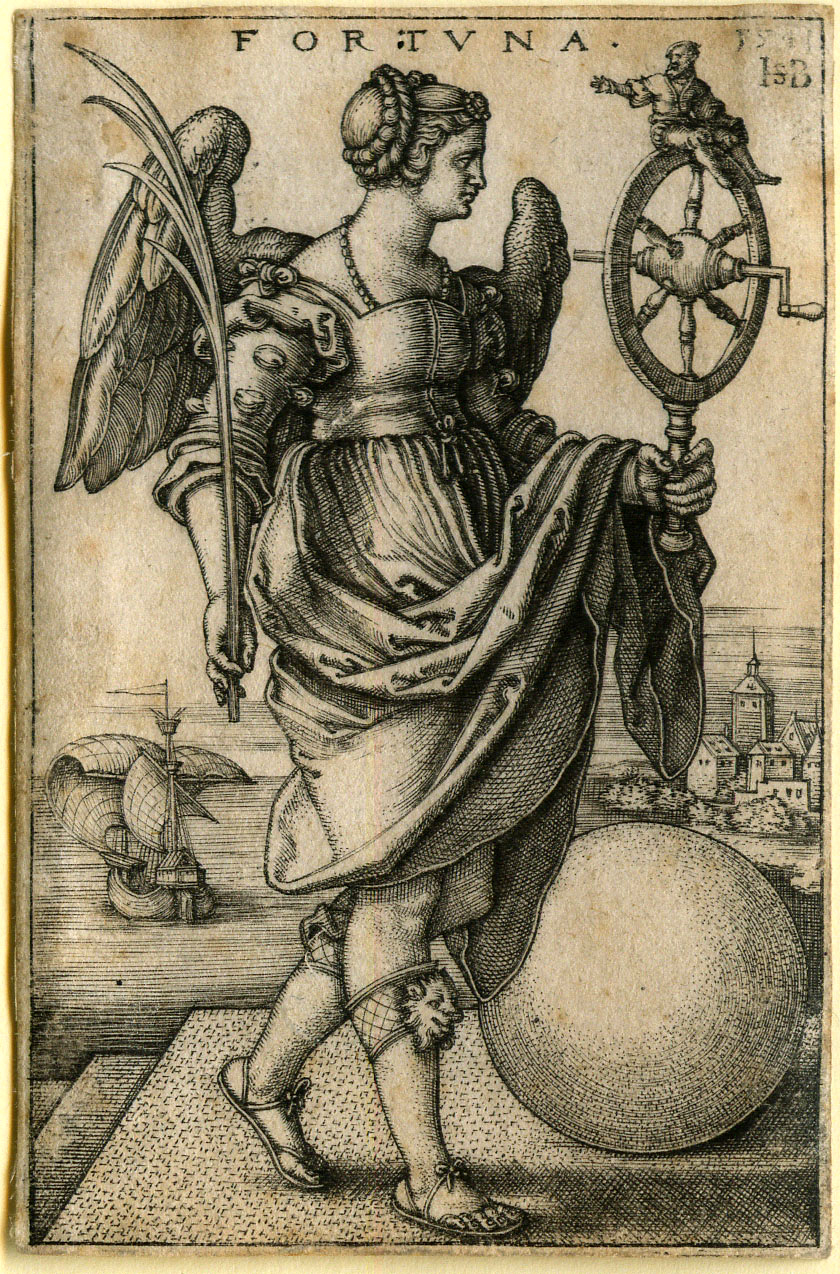
An ink illustration of Fortune: a winged female figure holding a ship’s wheel. At her feet is a sphere; behind her, a ship and a town.
This essay is part of ongoing reflections on value, culture and permissions that the founders of SO have been exploring in conversation and dialogue.
Something Other began as a research project funded by Arts Council England in 2014.
At the time of writing the funding bid, I was pregnant and looking for some financial security. I had been a freelance arts worker for ten years or so, living a precarious existence that was only possible because I had no-one else to be responsible for.
(I didn’t write the funding bid alone. Maddy Costa and I were working together at this point, soon to be joined by Diana Damian Martin. But these reflections on value and meaning are mine.)
The focus of the original research was:
1) to find ways to define the kind of writing we were interested in – this practice that a collection of writers and artists were doing, could recognise, but could not name;
2) to find ways to collaborate with creative technologists to present this writing in experimental and exciting ways online; and
3) to find ways to make this writing a financially sustainable practice.
I don’t know what I was hoping for. A career plan, perhaps? A model of sustainable and diverse income streams? A series of milestones on the route to professional status?
As I write, nearly a decade later, SO has not found ‘solutions’ to any of the ‘problems’ from our original research. This essay is an attempt to think through what that means.
(Against) Definitions
At first, SO organised a series of conversations with writers, artists, venues, and organisations to try to create a name for this practice. We recognised a type of writing and performance that lots of people were engaged in: a type that slid between forms, which was linked to performance art and theatre, to poetry and visual art, but was none of those things.
We wanted to find a name for it. But, as we talked and gathered with other people, we discovered the general consensus was that defining ‘this kind of writing’ would be a limitation. To name something is to control it, to confine it and, in many cases, to own it. Perhaps what we were doing did not have a name because it was uncontrolled, unconfined, and unowned. Perhaps it was not a product, but a process. Perhaps its value lay in the fact that it could not be described in advance.
This was a joyous revelation, and led directly to the formation of the Writers Gatherings: semi-regular groups for writers to come together and talk about ideas, with no need for definitions or productivity.
(Against) Commercial Models
As we continued our research, we also realised that there is no attractive (to us) commercial model for what we want to do.
There are models of course – for example, there are models of cultural reviewing and cultural journalism that pay writers, and there are models of literary journals that pay the people who run them. But none of these generates a truly sustainable income for a writer. More importantly, all of them invoke a hierarchy of meaning that relies on market forces and creates cultural gatekeepers.
We all have to interact with these hierarchies, but we didn’t want to use SO to reproduce them. We began to realise the ‘sustainable model’ we were looking for was part of the problem. How can we foster a sustainable financial model within a financial system that we don’t want to sustain?
(Against) Public Funding
There is another route for artists’ financial sustainability in the UK: to seek funding from trusts, foundations and the four permutations of the Arts Council to support individual projects, either directly or via commissions from organisations that make money this way.
This type of funding is also a form of cultural gatekeeping, albeit with relatively transparent processes. Over recent years in the UK these sources of funding have been negatively affected by a storm of factors (including the 2008 financial crash, the Conservative government’s ‘austerity’ policy, Brexit, and Covid). As the amount of money declines, the pressure on artists increases. We have to compete more fiercely for fewer resources, and we have to describe our work (the work we discovered was so happily indescribable) in other people’s languages of value.
Naturally, these languages of value are – in our cultural economy – countable. Countable things include money, numbers of people, and numbers of products or things produced. Countable things can also be the scores that audience members give to an experience on a scale that starts at 0. Crucially, all definitions of value must have a definition of the value-less – the nothing, the no-good. Research-based, speculative or unconfinable processes are difficult to account for in these terms.
And while this kind of accounting language is unfit for our purpose, there is another kind of counting that we couldn’t match from our original goals, either. We could not afford to pay creative technologists through the funding available to artists. Their fees were too high – defined, of course, by a different market place altogether.
Precarity, Permissions, Privilege
It quickly became clear that we cannot foster a sustainable model for our writing practice within a financial system we don’t want to sustain, and we don’t want to remould our work to fit a financial system that has other priorities.
What, then, is left for us to do?
There are two options available. The first is to leverage other people’s languages of value in order to make some money while trying to resist the imperatives of the organisations that are giving it to us, and to whom we have to prove our worth. This is a situation familiar to everyone who has a job.
The second is to opt out of the languages of value altogether, or to invent our own. The freedom of this second option is heavily dependent on external factors – on having another source of income, and a surplus of ‘spare time’.
Since that initial research grant ran out, we have been funding SO through a mixture of these two approaches, depending on what is possible for the three of us and our collaborators at any one time. Sometimes we are commissioned or funded to do a specific piece of work, and this enables us to carve out time from our other commitments. Mostly, we use our paying jobs to subsidise the time we spend on SO.
It is extremely awkward to be in this position.
It is awkward to have to bend your ideas to the language of people who need to measure art in countable ways.
It is also awkward to explain to people that we have no money.
No money to pay writers.
No money to pay for a venue.
No money to pay ourselves, even for the time we dedicate to generating money.
It’s awkward because we have to ask people to do things for free, and it is also awkward also because our culture aligns money with value. All three of us are still arts workers – our paying jobs are also part of the cultural economy – and we are deeply embedded into its systems of value.
When we don’t have any money for our own creative research, it feels like our creativity doesn’t have any value. Perhaps we are just hobbyists. Perhaps we are just egoists. Perhaps we are just people with too much time on our hands.
A third option raises its unfriendly head: why not give up altogether?
Silence
Where do these critical voices come from?
They come from the thrum of the wider cultural economy, which pretends that being in demand from capitalism is more important than being in conversation with life. They come from a capitalist system that is deliberately and strategically silent about the relationships between money and possibility – engulfing a cultural sector that relies on individual privilege to keep wages low and funding scant and competitive.
This individual privilege is naturalised through silence and shame. As individuals, we are all heavily encouraged not to mention the financial or social situations – as deliberate as an education, as contingent as a paying job – that mean we have some spare time and a place to live. We are encouraged to stay silent, as if our situation is unusual, as if we are the only ones to benefit from inequities, as if the whole system is fair and we are the only ones to have escaped its rigour.
But the system is not fair.
So why should we feel shame that the value of our work as SO is not linked to money? Why should we feel shame that the things we value about SO cannot be easily counted in capitalist systems? Why should we be embarrassed that we have decided to pool the resources of our luck and privilege, to do something that we find meaningful?
We start to think like this and we are buoyed with optimism! We are bursting with ideas and opportunities! There are conversations to be had, curiosities to be pursued, questions to be asked – an infinite, generative resource of thinking and sharing, with no output, no end point, no limits!
But then another problem, the biggest problem, arrives.
Hopes and Dreams
The biggest problem we face in terms of SO, its value and its sustainability, is that the rate of our ideas and our excitement far outstrips our capacities in terms of time or money. Things move more slowly than we like. We wonder what it is all for. We wonder if we are the right people to be doing this. We are overwhelmed by the rest of our lives, and we become cynical about our talents and abilities.
And yet, and yet, and yet ….
And yet, we move away from SO into other circles and we come back together. We realise that SO is the space, the idea, the proposition that we have been searching for. People tell us that SO is a space (an idea, a proposition) that they want to return to, or be a part of. We reflect on the work that we have read, watched, listened to as part of SO and we feel proud and grateful. We remember the conversations we have had as part of SO, the relationships that have been nurtured, the ideas that have been explored, and we feel energised and invigorated.
We think about the things we value – collaborating, listening, thinking, experimenting – and all their indescribable possibilities.
 Something Other