on The Talent by Action Hero and Deborah Pearson
by Maddy Costa
what had been a sanctuary, a thinking space, was being encroached by noise, the insistent cheer of commercial radio, first in the changing room area, then the toilets (who wants a DJ yacking away in a public toilet?), and finally over the pool itself, jingles, adverts, infiltrating the water, every time I paused for breath the unanswerable demand of it stealing thought away;
this used to be my life, growing up, adverts inescapable, commercial radio in the car when I was driven to school, at my parents’ work in the holidays, we were a TV on all the time house, it becomes so the adverts are indelible, you do the Shake ‘n’ Vac to put the freshness back – ambassador, you’re really spoiling us – you got an ology? you’re a scientist! –
older and older I get, more and more I forget, but these catchphrases from another era are going nowhere;
so it’s an odd feeling – not nostalgia exactly, more a wariness – when The Talent begins with an advert for breakfast cereal, a woman declaring ‘life is … complicated’, only to be asked by disembodied voices, her two directors, to find a new tone, brighter, simpler – they don’t say it, but more persuasive, more immediate, more attractive, more likely to make someone be attentive, which means buy the product – adjectives that feel at once arbitrary and precise, meaningless and pungent with hidden intent;
this is what I’m trying to avoid when I turn up to the cinema after the adverts have finished, rarely watch TV that isn’t on demand, feverishly click the skip button on youtube, these images of a brighter, simpler, happier life, in which you’re the best version of yourself, achieving your goals, following the plan on your own highway to success, finding your authentic voice; but it’s amazing how invasive this demand for attention, adverts filling all possible space as though another natural gas integral to the air, flexible, expandable, TV screens where once were billboards, adverts magnifying to take up multiple dimensions of space;
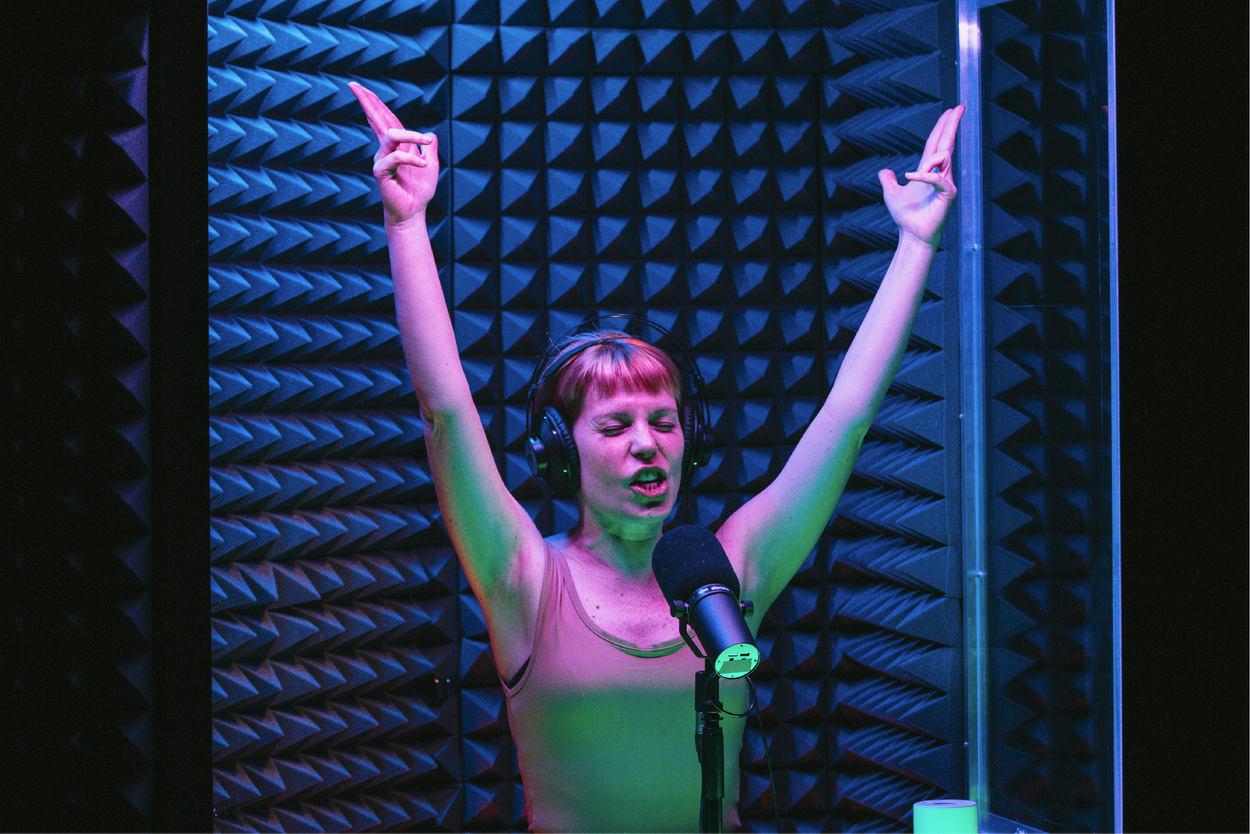
so it’s ironic, how small the space of the woman’s recording booth, a tiny box at the centre of a wide empty stage, a window to see her through, otherwise lined with soft ridged foam shaped like egg-boxes; and she seems robust enough but in a way she’s hollow, no life beyond these walls and window, not even dreaming of the open road to somewhere new (or the SUV that can take you there), a body housing only a voice, a voice that sells oats-so-simple, effective detergent, medications whose side effects include
happiness, which was a cigar called Hamlet, or a book on fly-fishing by JR Hartley, or a man in black abseiling through windows to deliver chocolates, or a sickly juice too orangey for crows, it’s just for me and my dog
a body that is hollow, because something has happened, some kind of (un)natural disaster, it could be a pandemic like ours, it could be war, nuclear, the ambiguity is part of the invitation and critical scope of The Talent: look, the work says, people can imagine so many ways to die, the woman performs a number of them, death by ray gun, stun gun, acid, nano-drill, electrocution, nano bots invading your body, your body sucked through a hole into space, each sound more inventive, more comic and entertaining than the last, people can imagine all these disasters, can imagine apocalypse, but can’t imagine a society not structured around buying and selling;
or, a society not structured around the necessity of work, work that defines existence, defines self, work as a moral good even: ‘I’m just trying to get on with my work’, the woman says, ‘I have my work, I can keep busy’ – or, as David Bowie says in Moonage Daydream, ‘Immersed in work I don’t have to look at myself, not deeply, anyway’ –
and I wonder: does the woman question what the work she performs with such consummate skill is doing to other people, how that work asks people to look at themselves with dissatisfaction, a dissatisfaction that can be resolved, of course, by buying the right, simple breakfast oats, or the right, effective detergent, or the right SUV without regard for cost to the environment; a dissatisfaction that can be medicalised and treated with drugs, that can be more softly treated with mindfulness apps, ‘you’re going to hear me ask you to be braver,’ the woman says, her tone kind, forgiving, because ‘what makes you, you, is a harder question than it used to be,’ because you want to ‘be the best version of yourself,’ don’t you? don’t you?
(and I wonder: what would Grammerly make of these sentence structures?)
look at it another way: it might be a padded cell, her recording booth, because it’s a kind of madness, to live this life, and go on living, to tend a tiny plant in a pot and call it nature, to remember adverts as cultural touchstones, to surround yourself with voices without ever a human connection;
or so it seems as I slip back into the pool, the radio turned off now, after a number of us complained, swim to a soundtrack of splash plish slosh, happiness in this silencing of commercial culture, in this temporary respite from what the world wants to sell…
 Something Other