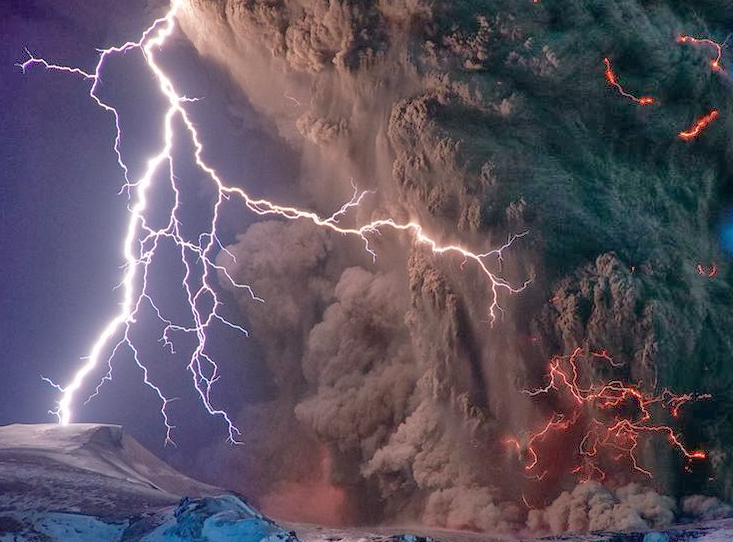
Image: Eyjafjallajokull Volcano, Iceland – photographer unknown
Matters of disturbance are central to the Public Order Act that has moved slowly but steadily through Parliament in the past two years, receiving royal assent in May 2023. It describes the ‘disproportionate’ impact of acts of protest on workers and businesses; the disruption caused by acts of protest to the police who are enacting their duty to keep the peace. Needless to say, the Act makes no mention of the disturbance to life, well-being or peace of people caused by the things many of the most high profile, recent protests have been about: the actions of fossil fuel companies, conservative politicians committed to neoliberalism, state sanctioned anti-trans laws, or indeed of the police themselves in enforcing the Hostile Environment and institutional discrimination.
Deciding what counts as disturbance is always a matter of point of view.
So writes Anna Lowenhaupt Tsing in The Mushroom at the End of the World, her study of matsutake mushrooms, which grows in the ruins of landscapes disturbed by global capitalism. ‘Disturbance can renew ecologies as well as destroy them,’ she notes, and while ‘humanists, not used to thinking with disturbance, connect the term with damage,’ thinking through the matsutake-nourished forest also enables her to see how: ‘Disturbance opens the terrain for transformative encounters.’ Disturbance suggests a normative state of palatable ease; disturbance is perhaps necessary in the imaginative production of change.
Following Tsing, Something Other’s Twelfth Chapter invites you to re-consider disturbance as ‘an open-ended range of unsettling phenomena’. Who and what is being unsettled? How? And what emerges from this new landscape? As always, language can be the tool of this disturbance, this unsettling, and also its quiet victim: think of how the language of care has been disturbed by austerity politics, drained of meaning and the warmth of interrelation. To say this is not to suggest that there is or has ever been some idyllic or utopian state of social organisation disturbed by acts of violence across history: in another helpful reminder from Tsing, ‘disturbance is always in the middle of things’. There is no ‘harmonious state before disturbance. Disturbances follow other disturbances.’
We invite submissions to the Twelfth Chapter: On Disturbance to disturb, disrupt, unsettle, and transform.
Before submitting, read our Editorial Guidelines here.
New to Something Other? We welcome you – find out more about us here.
Submissions close on the 2nd October 2023.
 Something Other