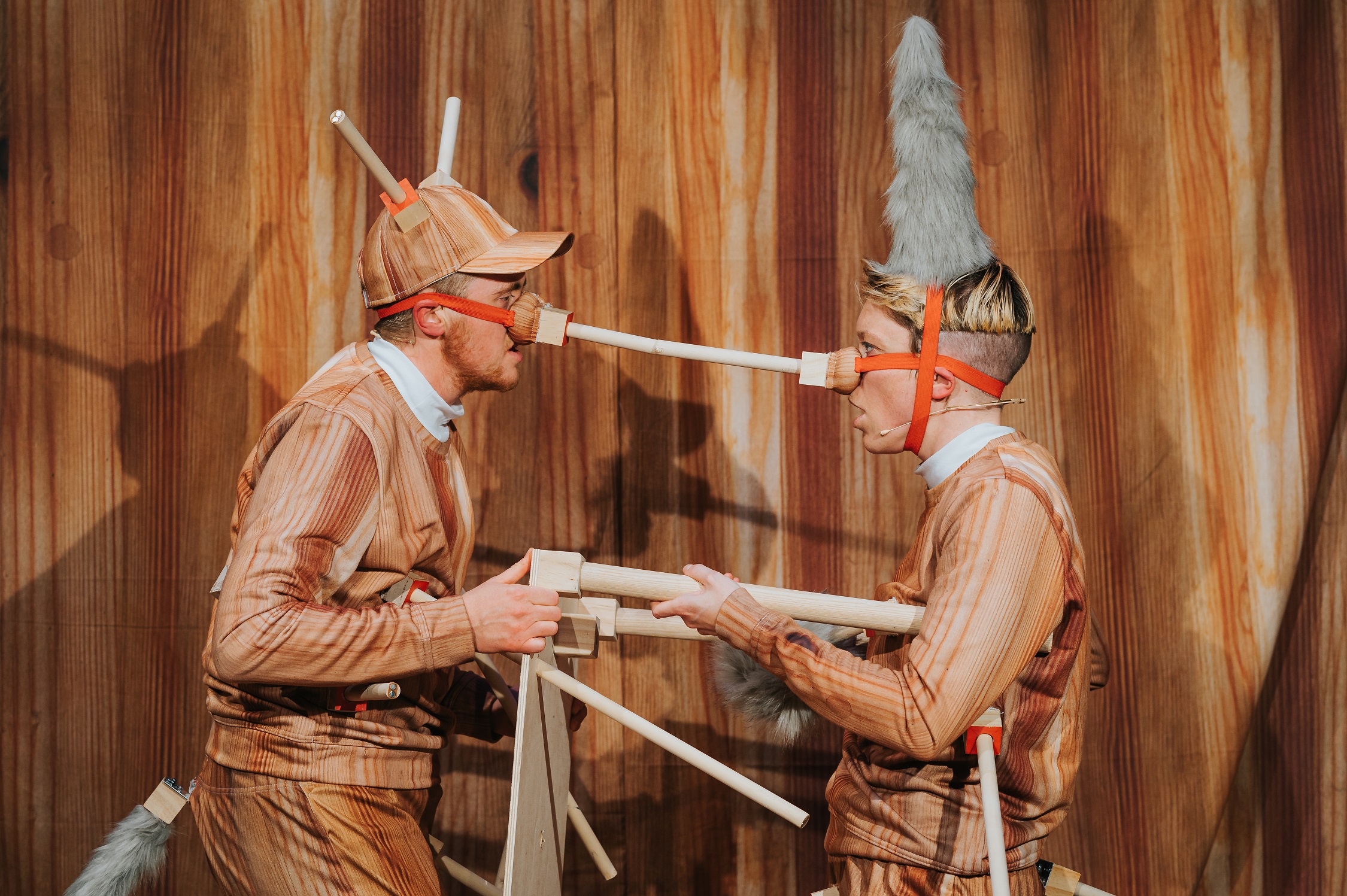
Photo: Tiu Makonnen
on The Making of Pinocchio by Rosana Cade
I have an ongoing queer love project making art and life with Ivor MacAskill.
In 2018 Ivor came out as trans and we began a process of working together over the next 4 years responding to this transition as a couple and creating our current show ‘The Making of Pinocchio.’
Using the story of Pinocchio, the lying puppet who wants to be a real boy, we were able to open up questions around what it means to be seen as real, and to have to prove your legitimacy to others. It gave us a playful framework to exploit ideas of truth and authenticity onstage.
The show is set in a fictional film studio where we are creating a strange version of Pinocchio, pleasurably employing a smorgasbord of theatrical and cinematic tricks – like forced perspective, mime, and puppetry – to bring the fantasy to life. The audience is able to watch the real action live in the space from one perspective whilst viewing the fantastical images we’re creating through the camera’s lens positioned at a different perspective stage left, projected onto a large screen at the front.
In the first half of the show there’s a distinction between the fantasy world of the Pinocchio we are busy creating and the ‘real’ world of the film studio where we are real artists addressing the real audience talking about our ongoing process of creation and our real lives. As the performance unfolds this distinction becomes blurred and the multiple layers of reality and fantasy are entangled.
‘Fantasy is what allows us to imagine ourselves and others otherwise; it establishes the possible in excess of the real; it points elsewhere, and when it is embodied, it brings the elsewhere home.’ (Judith Butler, Undoing Gender)
In order to change ourselves, or to change the world, first we need to fantasise, to imagine what could be. To be in tune with our desires. Queer artists forge gold in the cracks between the reality of the heteronormative world we trudge through and the utopic fantasies we reach towards.
Our four year process was bound up with this task, both imagining who we wanted to be, what world we want to create, whilst also imagining what the show would be, how these ideas could be embodied. And this was vital because we were creating amongst the reality of a toxic backlash of increased transphobia in the media and government.
‘In order to perpetuate itself, every oppression must corrupt or distort those various sources of power within the culture of the oppressed that can provide energy for change.’ (Audre Lorde, Uses of the Erotic: The Erotic as Power)
Too often trans stories are narrowly framed, conforming to a cis understanding of gender. We see an individual transitioning from one thing to the other, from boy to girl, with a clear before and after. This binary idea of change and gender is bent on trans assimilation, and limits all of us.
I remember Ivor saying he felt he had been diminished in the process of accessing medical support. He was forced to create a narrative around his life which would tick the right boxes, based on past trauma, to be diagnosed with a mental disorder, in order to prove his legitimacy and get the treatment he needed.
For us, it felt more real but also more thrilling to embrace transness as a state of possibility and fluidity, full of imaginative potential, and to see our relationship in this way as well. We are attempting over and over again to reframe the story, to find expansive and alluring aesthetic languages, to create a trans narrative focused on joy and pleasure, that fuels our erotic energy.
The framing of the show itself exists in that state, in the making process, where new ideas are still being dreamt up, nothing is finished.
It is an attempt towards an open ended narrative, a non-singular narrative. To create something that is multiple, that is about connections, that places us within a historic queer ecology, and as part of the ‘natural world’, with all its glorious transformations. This isn’t just a fun conceptual task – it was crucial to our mental health, our love, and our capacity to create change.
To love trans people, is more than to accept them, it is to be changed by them.
Through witnessing, supporting and being bound up in ivor’s transition, and also erotically engrossed in the process of making art about it, I had the opportunity to grow in response to him, in symbiosis. My sexual fantasies exploded with new possibilities. I’ve moved from a place I perceived as fixed – my lesbian identity – into something far more fluid, discovering new freedom and pleasure in how I see myself and feel in my body through identifying as non-binary.
We present this ecology of our loving relationship as a possible microcosm for how society could be responding to the increased visibility of trans people: from the solidity of the unchanging wooden world of patriarchal Gepetto, through red leather sex dungeon bdsm fantasy, via a giant inflatable tree monster and a chaotic pleasure island wooden-boy donkey fur orgey, to the slippery slidey fluid world of the whale’s stomach in the middle of the ocean.
We fantasise about a trans revolution that will propel all of society into a more liberated, fluid and hopeful reality.
Ivor: I suppose on one level it’s a love story.
Rosana: Oh Darling.
Ivor: It’s a love letter… To the theatre!
There is a scene in Pinocchio where he runs away from home, in our version from an unaccepting father, and ends up at the theatre. At first he is exhilarated to be in that space, to see puppets like him on stage dancing and singing and being applauded. But the owner of the puppet theatre soon recognises his ‘uniqueness’ kidnaps him and exploits him.
This scene gave us the opportunity to reflect on what the theatre means to us, and what it takes to make this show using our marginalised identities. Who is really pulling the strings and how much control can we have over this narrative?
During this process both of us have recognised that, despite the imbalance of power in our industry and our discomfort with a cultural trend towards consumption of people’s identities or trauma, we have found the theatre to be a space full of imaginative potential, where we’ve been fortunate enough to find the freedom from a young age to try out various personas and discover who we are in the process.
In making this show, and perhaps this was partly influenced by the pandemic, I felt reconnected to my childhood love of theatre and saw it as a place of magic, full of erotic energy. A place to dream up worlds, to take us somewhere beyond our lived realities, so that we might experience that transcendent space collectively with a live audience and over time, through repetition and embodiment, start to make it more real.
‘There’s somewhere between a truth and a lie where life takes place.’ (Jules Gill Peterson, Framing Agnes)
And now we are in that time of repetition. The show itself now has moved on from being in the making process, the state of becoming with multiple possibilities, to being ‘finished’, to being repeated. Whilst we are presenting the idea of something that is still being dreamt up and will never be finished, the reality is that it is the most finely tuned performance we’ve ever made.
The task now is tied up with re-learning the lines we wrote in the past, re-marking the stage so that we stand in exactly the right positions for the camera, repairing the wear and tear of the props and costumes to try and get them looking as good as they did before.
And we could start to see our process of transition in this way as well. That we are out of our cocoon. Out of the gooey slidey state where we were trying to reconfigure who we were. That Ivor’s second puberty has settled and the testosterone is doing it’s job. That we have solidified in a new mould and are living in its repetition.
But re-performing the show, revisiting these texts, is a reminder of our commitment to transness as a state of possibility, to being in the art of creating ourselves and our relationship, to allowing each other the space to be on the move, to grow, to change, to try something new. Through the show we remember this, and in the real world we attempt to hold onto this fantasy.
Or you could be the sea and I could be the sky.
Or you could be a star and I could be the moon.
Or we could both be puppets and just live in a theatre somewhere.
Or we could be the curtains in the theatre and spend our life nestled up next to each other. But then once a day, everyday, we move apart and something magical happens.
Or…
The Making of Pinocchio is on at Battersea Arts Centre until 10 November 2023.
 Something Other