by Tallulah Howarth
A sunny field in Dorset on a Friday afternoon. Emma Warren is discussing her book “Dance Your Way Home”, which follows the evolution of the dancefloor spanning decades of club culture. Warren wrote it to illustrate her own belief that dancing is a human need, a human medicine. I had an unexpectedly emotive response to this discussion, but couldn’t quite articulate why. I later have come to realise that, for me, dancing has been a personal revolution: a tool for disturbance, rippling out beyond the individual.
Warren was speaking at We Out Here, Gilles Peterson’s marvellous feat of a festival that takes place each summer in Dorset. I was there with thousands of like-minded jazz, soul and Afrobeat lovers, including a group of friends of mine from Leeds, of whom I would describe myself as very close to only one. It was comforting to have both the freedom of selective aloneness and an available camaraderie for late-night trooping. It was during the late-night trooping around the site that magic started to happen.
Two members of our group, Rob and Amani, have trained to varying degrees in dance, movement and contact improvisation – and this information wouldn’t have surprised anyone in their vicinity. Above all, there was an implicit comfort in their movement and in inhabiting their own bodies that feels quite alien to me. I was in awe of their confidence and skill, but also envious of it.
I spent a portion of the weekend feeling anxious. Trapped inside myself. Inexpressive and frozen. Self-conscious of the skin that I am in. This embodiment is something I have struggled with for a long time. In college, my drama teacher lamented trying to get my body to comply with Brecht’s exaggerated characterisations. When I perform poetry onstage, I can rarely force myself beyond politician-esque gesticulating with my hands.
Contrastingly, I have wondered if the ability to be present in my body and its power during sex (good, safe sex) is one of the reasons it can be so liberating.
Throughout the festival, I followed this line of enquiry. I had conversations with new friends about the need to dance. I observed fluid movements and muted two-steps, and the spectrum of dance in between. For me, the divide did feel gendered: those with more social capital, having a more positive body image or greater level of general confidence. Generally, I noticed how a lot of younger people seemed to need explicit permission to dance, to be told they could. How overwhelmingly, those who were dancing freely seemed to be men, taking up more physical space on dancefloors than women did.
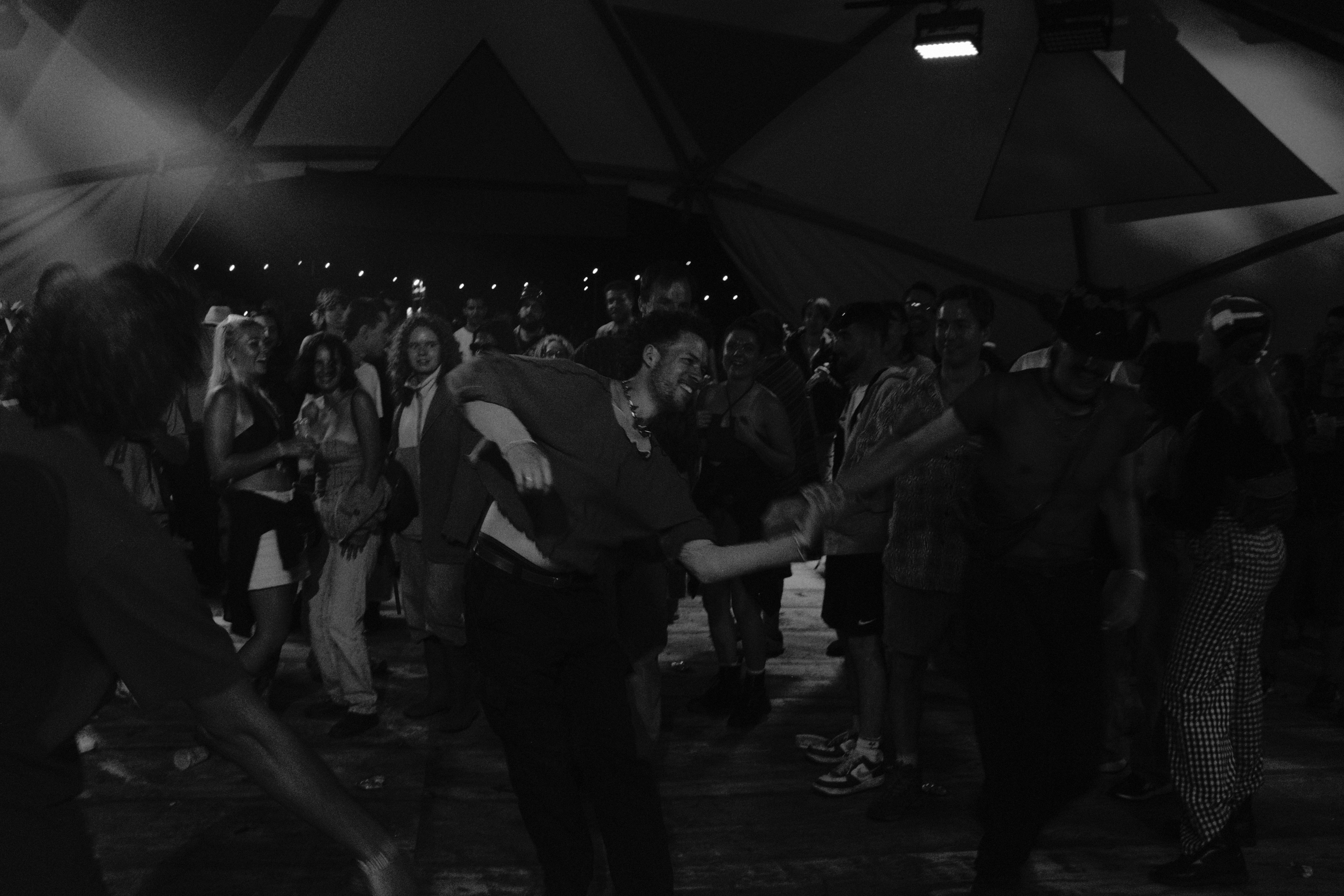
This was especially clear when, one evening at the Hennessy bar, Rob, Amani and Luka accidentally created a breaking cypher. A cheering crowd formed around them, filming and encouraging the free-flowing collaboration. I noticed that men, and older dancefloor veterans, had the confidence required to undergo the act of entering this kind of space. I noticed as I, and lots of other women, stood on the periphery of the circle, watching.
A new acquaintance agreed with my admiration of our friends’ dancing. “They were absolutely mesmerising. Their bodies were like water,” she said.
I thought: What if we women could be water too?
Then, something beautiful happened. The boundaries between the dance circle and the rest of the tent were dissolved as people were invited in and included, regardless of their skill or confidence. As the set by RSL peaked, we shared a renewed energy.
Over the weekend, I played games with my body. In the Lemon Lounge, Amani and Rob supported me to loosen up by joining them, offering movements and limbs to each other, spinning round to command space was made for us. This felt unnatural. As we waited for Alogte Oho and his Sounds of Joy to begin, I asked Amani to do some contact improvisation with me. He told me to move my body towards his hand, like a flower growing towards light. Then, to close my eyes and carry on moving after he had taken his hand away. When he asked me how it felt, I said “I feel silly, but that’s ok.”
I am by no means saying that gender or social capital is the only factor within our struggle to dance. I spoke to a diverse lot of people who echoed this feeling of self-consciousness and perceived judgement that stopped them from dancing the way they desired. Shame is a learned response. We are children before we know shame, before we are taught it. We must actively unlearn it.
Under the right conditions, I have danced transcendentally. Namely, in small sweaty rooms surrounded by people that I love and trust, to music that I live for.
The Leeds-based club night ‘Bodies in Motion’ is the manifestation of what this essay is trying to say, being ‘a party with space to move’ that holds the healing power of communal dance in high esteem. At a party of theirs I attended last year, a friend of mine clocked a few men dancing topless and told me she wished she could do the same. Fresh Junk, the organisers, manage to create an environment so safe and expressive, that my response was: “Come on then, let’s do it. It’s the last song.”
We must interrogate the colonial roots of internalised fatphobia, and claim our bodies back for joy! A comment my therapist made also rings true here. If you experience trauma or abuse, or have your boundaries violated, it can be easy to disassociate from your body and fail to see it as your own. So, dancing forces you to confront that dissonance – to associate, to take ownership. Think of how dancing can be a personal revolution. A way to say: this is my body, and I have autonomy to do with it what I like. I want to move in this way and I don’t care what you think. Artists, musicians and promoters are doing a spiritual service. This is pastoral care. This is community care.
A special thank you goes to the previously mentioned Amani Talheth-Fell and Robert Sahakyan for inspiring this article, and for their service, alongside Luka Abeywickrama, as the Fresh Junk Arts collective.
 Something Other