Sense-Ability: a response to The Sense of Life (Theater and Dance with AI robot), by DieTanzkompie* by Lisa Moravec

This autumn I took the train to Esslingen am Neckar, in the South-West of Germany, to see Grégory Darcy’s DieTanzkompanie performing with their NEURA ROBOTICS arm MAiRA. Founded by a studied engineer of aerospace, visiting researcher at N.A.S.A., later turned choreographer, the company brands itself as “the world’s most advanced inclusive dance company gathering choreographers, scientists, professional dancers, and A.I. robots”. It comprises of professional dancers, abled and disabled-bodied children and adult dancers. I was particularly curious to see how the director of the company integrates an A.I.-steered industrial robot in his dance company, and what the presence of the semi-autonomously moving machine does to his choregraphed dance aesthetics.
Over the past few years, performances with A.I.-steered robots have been increasingly shown in black box theatres. This global trend goes hand in hand with specifically initiated research labs all over in the world, where scientists collaborate with performance and dance artists. They take the biomechanics of the human body as a model to learn more about how they can program robotic machinery to move more like, and interactively with humans. In such futuristic, university-based collaborations between art and science, the aesthetic practice of dance, however, takes a backseat as the dancers merely operate as corporeally moving interfaces which the scientists study. While the dancers have to move in much more simplified and slowed down ways in such scientific experiments, the robots appear motor-sensorially incapable to move in close and immediate interaction with the dancers in real time. This makes clear that robots are, despite the pairing of embodied A.I. with material hardware, still not able—to even partially—imitate the abilities of human body-minds. In the performing arts, the inclusion of A.I. robots does, in turn, provoke questions concerning differences and similarities between dance’s conceptually and corporeally defined vocabularies, and the increasingly autonomously and responsively moving robots. The inclusion of such mechanically moving robots in dance performance therefore prompts us to reconsider how we think about dance, and above all, about what it means to be human.
As the company has been invited to perform at popular science and technology festivals this year (such as at the Wissenschaftsfestival and the Medienpolitischer Kongress in Stuttgart, or the Falling Walls Science Summit in Berlin), I expected the performance in Esslingen to show off some of the latest robotic A.I. technology alongside its dance language. But my expectations remained unrealised. Upon arrival at the small Kulturzentrum, located in Dieselstraße, my curious overexcitement to perhaps see the performance of a polished aesthetic human-machine synergy was thankfully cooled off by the warm, welcoming, and intimate atmosphere of the space and the people coming to see the performance. The gathered people did not seem to belong a hipster performance audience, but appeared to me to be predominantly locals, gathering to see friends or watch their children perform –a grounding community feeling. As I arrived a little early, with hardly anyone being in the theatre space, I decided to change seats twice and ended up sitting at the far-left corner of the first row, where I had a clear view on the single industrial robot arm standing, literally still, waiting and not moving, in the very back of the small dark stage.
… A feeling of not belonging spread within me…
When the performance started, an energetically and yet softly moving group of performers started to collectively take over the stage. Three or four abled-bodied dancers moved gently across the space and, at the same time, helped the dancers with Down’s syndrome to also follow the pre-set choreography. The tenderness and communality of the group dance set the diverse-bodied aesthetics of the performance. As abled and disabled performers danced sensually attuned with each other, The Sense of Life presents, from its very beginning, an aesthetics of sensibility. It is a performance that materialises not through idealistic, skilled approaches to dance, but it comes about through direct inter-corporeal and sensual communication, giving way to a sense-able form of intersubjectivity by cutting across binary conceptual and epistemological understandings of physically abled and disabled individuals.
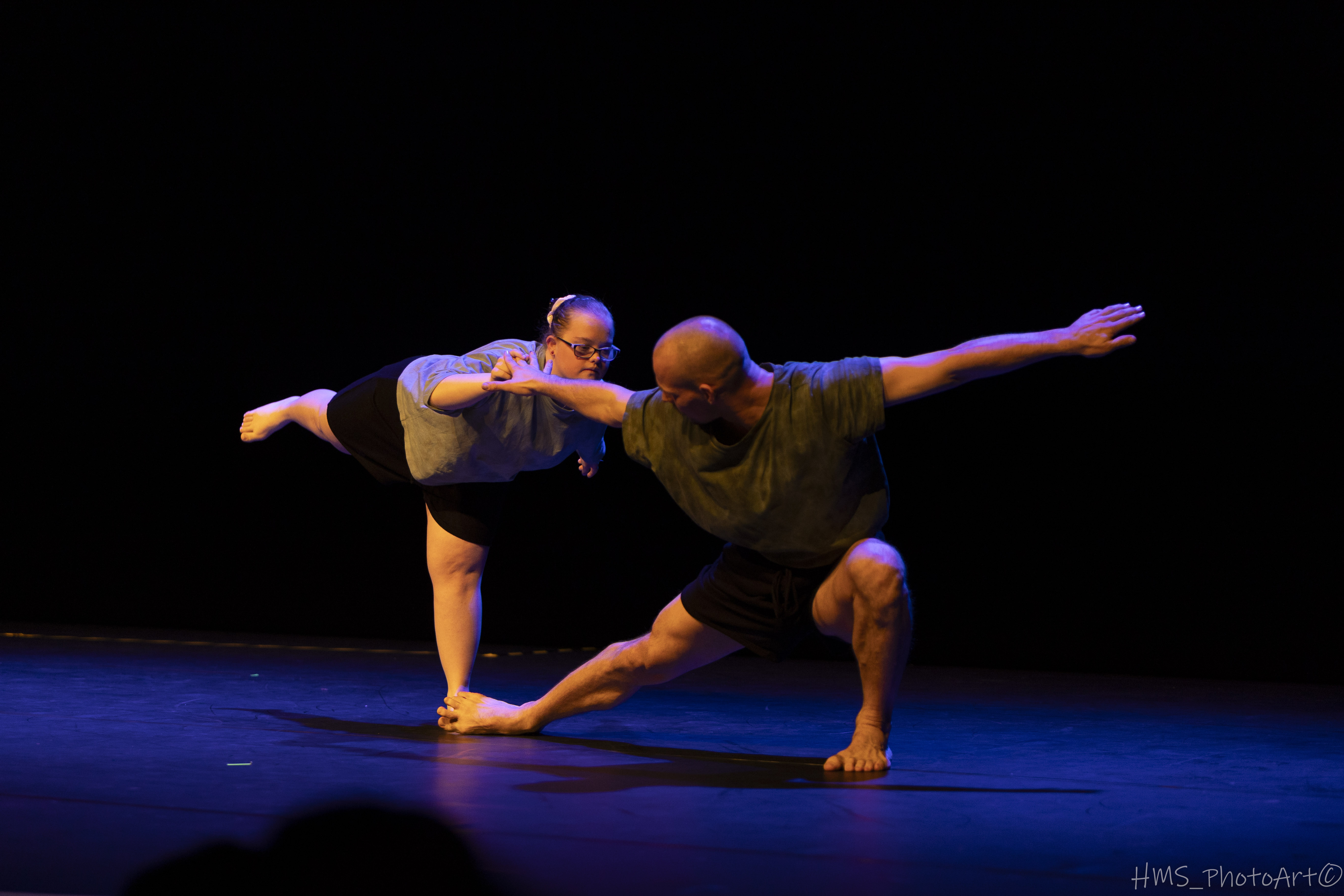
In the duet between Johanna Wichmann (a teenager who embodies an extra chromosome 21) and the professional choreographer-dancer Johannes Blattner, the feeling of sensibility already comes to an initial peak. Already in the group dance before, the same female dancer stuck out because of the gentleness of her movements and the attentive gaze, with which she watched the others moving across the stage. And later, when she dances joyfully, in synchronised interaction with Blattner, it is not possible to see who of them leads their tender, intercorporeally entangled movements.
In the parts of the performance when the dancers move highly consciously, next to or in direct connection with one another, a touching feeling of an emotional corporeality also unfolds. Their performance contrasts a specific approach to dance which presents abled-bodied stage dance often as a fully prescripted and overly rehearsed, conditioned bodily aesthetics, rather than as a clearly perceivable authentic and sensual bodily experience. Because Darcy’s company provides insights into how different human sensorial perceptions play out performatively, The Sense of Life prompts us to question approaches to dance in which choreography is corporeally inscribed through social conditioning rather than through immediate intersubjectively responsive bodily sensations. While the former relies predominantly on the repetitive training of specific movements, the latter relies on subtle transfers of energetic impulses, going from one body to another.
…I cannot remember a dance performance that made me so fundamentally reconsider bodily perception…
The sensually moving body and its mechanics is further explored in the dance performance when three young women play three animated robots. They are dressed in silver and blue costumes, resembling the appearance of MAiRA, the robot arm. The theatricality implicit in the gendered dance performance of the three robotic graces—which is how I perceive of them—neatly foregrounds how post-industrial mechanisation and A.I.-based automatisation impacts the body. Over time, with repetition and habitation, interactions with machines not only shape our movements but also our consciousness.
The material juxtaposition of robot and performer, enacted through living human mimicking, points towards physical alienation kicking in, when human movements are artificially made to perform monotonously, or in restricted ways in specific (and all too often still gendered) task-based labour processes. The lively performance of the women sharply contrasts with the robot’s artificial movement aesthetics: while the animated performance of the robot can, indeed, be read as a posthumanist (human-machine entangled) aesthetics, the imaginative human-machine aesthetics of the robot performers remains, above all, exclusively human material. The shining silver costumes and colourful make-up of the dancers reinforce this through their facial expressiveness—the robot-women exhibit nothing else than explicitly human, (e)motional features. And yet, The Sense of Lifedeconstructs, with its “inclusiveness”, normatively installed cultural understandings of what counts as an aesthetically moving body.
Throughout most of the performance, the A.I. robot arm stands passively in the back of the stage. And even in the scenes when the robot is more actively involved, with simple moves according to its machine ability, the dancers continue taking centre stage. With this smart dramaturgical decision Darcy’s dance performance prompts us to reconsider conceptions and sensual perceptions of diverse human and automated machine abilities. Just as humans’ physical conditions and modes of perceptions are subjective and depend on their social uses and functions, machine ability does too. The involvement of one industrial robot in the human dance performance subtly foregrounds that as bodies are diversely abled, it is problematic to further separate them into abled and disabled people. While The Sense of Life tackles binary thinking about disability performatively, by choreographically grouping all dancers together, the use of language to describe the dancers seems to me to be more problematic to do away with.
To avoid discriminatory language, the UN’s Convention on the Rights of Persons with Disabilities defines disability as “an evolving concept”, which “results from the interaction between persons with impairments and attitudinal and environmental barriers that hinders their full and effective participation in society on an equal basis with others” (Preamble). To not essentialise and classify people based on their (visible and invisible) dis/abilities, the UN agreed on the description “people with disability” (2006), with the World Report on Disability, published by the World Health Organization, further elaborating that “disability is part of the human condition”, with almost everyone will be temporarily or permanently impaired over the course of their lives due to difficulties to see, hear, talk, or walk.” (2011, p.3).
Specific technology can provide remedy or a relief when experiencing difficulties with sensual perception causing disabilities. While humanoid service robots are going to be increasingly used to support social care and human wellbeing, industrial robots are produced to conduct specific manual labour instead of humans. As The Sense of Life brings diverse human physicalities into dialogue with the robot on the stage, the dance performance successfully does away with binary conceptions of ability and disability, and draws attention to the subjectivity of conceptual and sensual perception. That said, the robot is not a main character in the performance, but it provides a lens for watching sensually moving bodies in relation to a specifically-preprogramme machine.
…my critical writing on performance thinks through forms of corporeal sensibility…
Towards the end of The Sense of Life, some of abled-bodies dancers perform as military soldiers while the three robotic graces watch them. Then, the founder of DieTanzkompanie appears as the military leader, speaking to the audience about what they are doing up there. And in another scene, a group of performers with diverse abilities perform together in a dramatic constellation. This gives the impression as if they were in a war scene. With this, the performance’s lyrical narrative seems to reinforce the crux implicit in working with people: social relations, hierarchies, and dynamics are shaped by diverse abilities, skills, and intentions.
Eventually, DieTanzkompanie’s staging of social interaction through bodily communication between people with differently abled bodies bags the question: how can we conceive of dance more as a socially shaped aesthetic practice, and less as one that is formally developed? If the body in motion is presented as the means of sensuous expression, as one that is not other but similar to verbal language, contemporary dance does indeed actively shape its own vocabulary and sensual approach to bodily interaction. This is what watching The Sense of Life did to my understanding of corporal sensibility.
And yet, on a self-reflexive level, my subjective experience of this dance performance presents my aesthetic appreciation of it, entangled with a larger societal critique of classifying and treating people based on their bodily abilities. But, how able are we really, or have I been here in this text, to circumvent positions of power when we verbally describe an artistic performance or make aesthetic and performative value judgements? Might humour, as in the scene with the three robot graces, offer a way to create a critical distance to the subject that the critical observer analyses? With the three robot graces being neither human nor machine, but humans who embody machinic characteristics, their fictive figuration on the stage ventures into the realm of performativity—it opens up one possibility to circumvent essentialist and historically inscribed categorisations to the physical, and therefore human condition.
As everyone is or will be faced with partial or temporary disabilities throughout the course of one’s life, the bodily sense of sensibility is key when inquiring how criticism and corporeality can be less critically conceptually, and more intuitively somatically performed. Writing on artistic work should, I believe, crystallise – similar to the dance performance of The Sense of Life – that we need to continue shaping a way of non-discriminatory thinking that we can practice, both bodily and verbally.
… self-reflexive and performatively…
* Original German title Der Sinn des Lebens (Theater and Dance with AI robot), 23 October 2024.
All photos: The Sense of Life, DieTanzKompanie by Gregory Darcy, ©HMS_Photoart or ©Heiko Pothoff.
Lisa Moravec is a performance scholar-art historian, critic, and curator. She works at the intersections of the performing and visual arts, with a focus on human, animal, and machine agency. As senior postdoc at the Academy of Fine Arts Vienna, she leads the FWF research project The Performance of Critique: AI, Bodily Intelligence, and Posthumanist Aesthetics. Publications include Dressaged Animality: Human and Animal Actors in Contemporary Performance (Routledge, 2024), co-ed. ex-cat. Suddenly Begin in Splendour: Rose English (Distanz, 2024), book translation What is Vienna Actionism? (DVC, 2025), the co-ed. vol. Posthumanist Approaches to a Critique of Political Economy: Dissident Practices (Bloomsbury, forthcoming 2025), and art/performance criticism e.g. in Spike, springerin, Texte zur Kunst, and Studio International.
 Something Other