On Container at New Diorama, by Maddy Costa
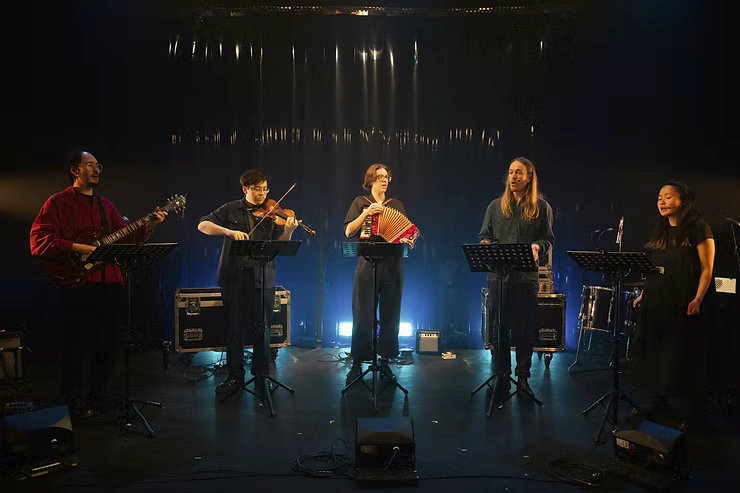
It’s a gradual opening of Container. First the slow entry of the audience, five performers already on stage, making eye contact as we file past to our seats: yes, we are in this space together. Then the focused attention of the performers on each other, eyes locking then shifting then locking, Alan to Jemima, Clara to Tim, Ben to Jemima, Alan to Clara, Tim to Ben: it’s like watching a rehearsal room response-ability building exercise, something invisible or inaudible thrown between them, a ball, a name. And then they do start to speak, single words intoned together. Damsel, they say, and my mind, playing its own word association game, immediately follows in distress. The seen and unseen, the spoken and unheard, connection intended and inferred. It’s as though we’ve been slowly unwrapping something together, layer by layer, and here, in this moment of implied distress, is where Container reveals itself.
Container contains distress: it is a response to a lifetime of witnessing violence. Its writer, Alan Fielden, was 15 when the twin towers fell, still wasn’t allowed legally to drink when Amnesty and the Red Cross began revealing the torture of detainees at Guantanamo Bay, was at university when the financial crisis of 2007/8 began to unfold. His early twenties were punctured by Theresa May’s declaration of a Hostile Environment, designed to deter “illegal immigrants” but of course affecting anyone who isn’t immediately understood as white, the repression of the Occupy movement and the Arab Spring; and his late twenties by the EU referendum, its xenophobic glory fuelled no doubt by disgust at the Calais “jungle”. And what did his thirties bring? People dying in the backs of lorries, in small boats, in desperation; parenthood coinciding with the intensification of Israel’s military attacks on Palestine, his child’s first birthday the same year as Amnesty concluded that yes, this is a genocide.
This timeline is just a few lowlights, of course. It doesn’t even mention Trump.
It’s also an adulthood in which the world has reduced to the size of a machine that can fit in your pocket. Phone as container of global experience, global violence – the joys of humanity too? Yes, but it’s harder and harder to feel them, locate them. And then somehow the body has to contain these things thrown at it, however pummelled the mind. Day after day getting up, brushing teeth, eating, working, parenting, remembering to keep up with friends, taking refuge in music or collapsing in front of the TV, going to bed, no matter how meaningless it all feels, how futile, how abominably privileged to be able to do these simple things in warmth and safety and comfort.
This is and is not what Container is about.
About is a stupid word to use here, as reductive as relating the experience to the specific biography of its author. Container is an invitation to think in company, to question yourself, your ethics and values, where you place your attention, how you respond. It is an invitation to develop response-ability. Like the samurai in one of its stories, sure, you can respond to the humans around you with violence and rage, make a grab for power that diminishes life. Or you can put those weapons down. You can be the passive person, as in the sequence evocative of Guantanamo, who didn’t torture anyone, who didn’t tie anyone up or untie them, who didn’t cut off anyone’s hands because the hands were cut off when you got here. Or you can actively seek to build the community alternatives to state violence, alternatives rooted in transformative justice and mutual aid practices. Still complicit, but at least trying. After years, decades, of accepting society as it is, I’m at last orienting towards the latter.
Container is also a consideration of what theatre is doing when it contains a number of people in a room. How is it telling stories? Why is it telling stories? Who is it telling stories to, and whose stories is it telling? Container tells a number of stories and none. Like that damsel in distress, it relies to some extent on your recognition of certain events, risks its emotional impact on those internal associations. When one of the five performers (I don’t remember and it doesn’t matter who) alludes to the body of a boy found dead on a beach, instantly I recall Alan Kurdi, the tiny Syrian boy whose photograph provoked international outrage in 2015, see the red and blue of his clothes. And I’m appalled at myself, because I haven’t thought about him for years. All that outrage, all that horror, and here we are, ten years later, and who can count how many more millions of humans have needlessly died.
Aristotle argued that theatre enabled its audiences to experience catharsis: the encounter with misery, tragedy, horror that, because it happens in a “safe” environment, because it isn’t “real”, enables a release into relief. Ancient Greek drama, the theory goes, staged social upheaval to remind its citizens how good their lives really were. This is among the reasons I’ve come to loathe the ancient Greeks for their democracy-that-wasn’t, that depended on exclusion and inequality, and think Aristotle was a twonk.
Container doesn’t offer catharsis: if anything, it coaxes all the despair and horror that is bottled up in mind and body to the surface until you feel like a bird in an oil spill. The first time I saw it I felt awful, churned, miserable, but also grateful: because the work felt brave and genuine and loving – it literally ends invoking bodies of love. I went to see it again four days later (and would have seen it a third time if the run had continued for another week) because it contains the proverbial multitudes and I knew it needed more attention. The second performance was bigger, more emphatic, more “performed” somehow, and I “liked” it (another reductive word”) a little less, preferred the muted quality of the first performance I’d seen, the impression it gave of a text moving through its speakers, as though its own life force, a text implacable but also generous: yes, modern life is a kind of hell, but if we’re in this room it means we still have choices, we still get to choose how that life is shaped.
The reality of living in enforced consumerism, in a capitalism that hasn’t yet exhausted its markets or scope for expansion, is that many of those choices involve where people put their money. Unlike theatre buildings, which come in all shapes and sizes, shipping containers – this is a piece of text delivered by Alan himself, also a choice, a statement of sorts – are standardised: the exact same dimensions everywhere. The ideal capitalist product, easily interchangeable with each other, travelling smoothly around the world. After seeing Container the first time I had a brilliant conversation with Flo Dessau, a dramaturg I’m getting to know since she was awarded the dramaturgs’ network Fellowship in 2024, who joined my post-show Theatre Club also feeling wretched, not least with shame: a chunk of Container lists products shipped around the world, and so many of those, Flo said, I own, and for what?
It is tedious to say, po-faced moralism of the most tendentious and unappealing kind, but until those of us caught up in capitalism recognise the ways in which we make capitalism every single day, in which every choice we make about what we buy contributes to this deplorable system, nothing will change. Container doesn’t deliver this as a lecture and nor does it condemn. It invites its audiences to consider and offers understanding. You feel shit and we do too.
The nights I saw Container I was in the middle of reading Active Hope: How To Face the Mess We’re in Without Going Crazy, a book by Joanna Macy and Chris Johnstone, having experienced – at the risk of sounding ridiculous – a paradigm shift within the first three pages, at the exhortation that you don’t have to be hopeful to act hopeful, because hope “is something we do rather than have”. A choice: “Since Active Hope doesn’t require our optimism, we can apply it even in areas where we feel hopeless. The guiding impetus is in intention; we choose what we aim to bring about, act for, or express.”
What Container offers is that hope within hopelessness, that reminder of the power to choose within a society that locates power in, indelibly associates power with, cruelty and hate. It does this not by ignoring distress, the way I, for months now, have been ignoring the news, but sitting in it, sorting through it, allowing the overwhelm and still doing what humans will do even in conditions of extreme distress: telling stories, making music and song, building connection.
I wasn’t going to write about Container because its dramaturg, Diana Damian, is my friend and co-curator of Something Other, because two of its performers (Jemima Yong and Clara Potter-Sweet) are friends I don’t see enough but adore, because its writer and another performer (Alan Fielden and Ben Kulvichit) are also people I like hugely and will chat to happily after a show: it’s too close, right? And I also wasn’t going to write about it because I’ve basically run out of paid work and that’s what I need to keep myself in theatre and cinema tickets (escapism) and to fund the time I devote to mutual aid (active hope). I had to set myself a strict two hours to write about it and upload it because this is time I’m supposed to be using for job applications.
I did that because Container wanted me to write about it. It has sat on my desk, a piece of paper covered in notes, starting with “if I were to write about Container”, asking “when did writing about theatre start to feel pointless?”, refusing to be buried beneath all the other pieces of paper, possible writings, different ideas. It wanted me to write about it because there is a sequence in which the words “everybody” and “anybody” are intoned and I want to remember, always, how this life of safety and warmth and comfort is not a given, that fate twists so quickly; in a flash, a friend has gone from not-yet-disabled to disabled, just by falling off her bike. Container wanted me to write about it because there are reviews out there that say things like:
This is an interesting, if slightly underwhelming, performance despite great intentions.
This is an unfocused, unrestrained piece.
In its pursuit of structure, it sacrifices theatrical vitality. What emerges is a performance that is sharp in thought but distant in feeling—clever, committed, and often compelling, but emotionally unmoored.
Strangely, for a work with a text that seems to seek to directly address its audience, to create empathy with the victims of inhumanity, Container makes little attempt to create any real contact until nearing the end.
While even the positive reviews say things like:
It’s easy to walk away from Container unclear on what its central thesis was.
At its most powerful it is electric, but the deliberate opacity frustrates and diffuses the effect.
But maybe the deepest reason Container stayed with me, insisted I write about it, the reason I wanted to write about it, is the sequence when Clara starts saying, over and over: “I can’t stand it, I can’t take it any more, I can’t stand it, I can’t take it any more, I can’t take it any more, I can’t take it any more”, louder and louder, and there it is, the voice inside my head, its cacophonous distress, and how bleak and consoling it is to know that voice isn’t mine alone, to hear it not contained but shared.
 Something Other