Circling thoughts on Delay at Bristol Old Vic, by Maddy Costa
A useful thing someone once told me about sci-fi is that it comes in two varieties, hard and soft: the hard kind is more concerned with the science, the soft more with the fiction, the emotional stuff. I offer this less to provoke debate, more as a confessional: I needed insight because sci-fi is a field I enter rarely. When I have engaged – most recently, with Ursula K Le Guin’s The Dispossessed, a galvanising study of social contrasts, mutual aggression compared with mutual aid – I’ve found myself frustrated by all the world-building that has to go on, the explaining of everyday things in a defamiliarised environment. Which is daft, because how many environments, contemporary or historical, are familiar to me? People live differently all around the world: sometimes the only way to encounter those differences, imagine other lives, is through their depiction in fiction, in art.
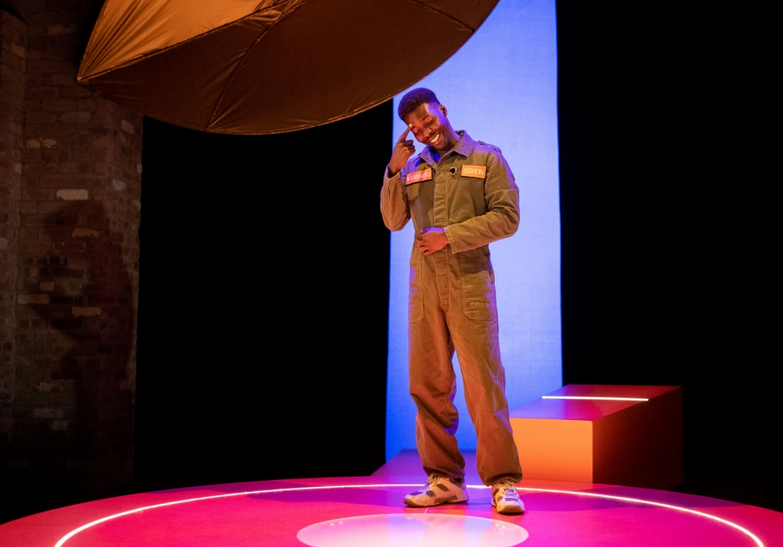
Delay is on the soft side and even so, its science befuddled me. On stage is Lin, sole inhabitant of a craft that is hurtling through space, carrying a human gene bank to a planet where people might establish a new earth, having ruined this one. Time expands with distance so that each of Lin’s days becomes days, months, years in the life of Silas, the lover he left behind: a sacrifice Silas admires but somewhat resents. The structure sounds clear and simple enough when I write it out but my experience of watching the play itself was more of repeatedly jolting as I tried to wrap my head around its mathematics. And these jolts created a tremor of disbelief: a struggle to believe in the situation, the characters, their relationship.
Actually, that’s not totally true: to the degree that it described the collapse of planet earth, I did believe in the science part. Delay happens decades into the future, and catastrophe is hinted at in messages from Silas: “another pandemic”, from a virus defrosted through global warming; repeated heatwaves; dark skies without rain, “so there’s not even rainwater to filter”; fear and rage and dread without hope. Lin’s love for Silas also made sense, because he is still a young man through the action of the play, absent barely a year. What I struggled with was Silas – heard through a series of recordings, spoken with passion by Alex Lawther – remaining committed to this lover of just three years, someone he met in his twenties, as he grew and aged and presumably changed, decade after decade, still alive into his 90s, without falling in love or starting a relationship with anyone else.
Presumably, assumably. Assumption is very present in my mind this month because it’s integral to the argument of a book I’m reading, Julia Serano’s Whipping Girl. Published several years before the “trans tipping point”, before the current tsunami of transphobia, before Trump and JK Rowling, but rooted in an older wave of trans-exclusionary (and indeed dyke-exclusionary) feminism, Whipping Girl invites a radical rethink of transphobia – or rather, the specific strand of transphobia that denigrates trans women. Serano posits that it’s misogyny at play, a misogyny that interweaves traditional and oppositional sexism: traditional being your basic patriarchal “men are best” sexism and oppositional being more of a “men are from mars, women are from venus” sexism. Serano’s incisive argument is that gender is multiply located, in biology, physical characteristics, socialisation, but also the eye of the beholder: each of us gendering others based on what we assume from what we see. Mummy, that’s a man, says the small child, befuddled by my spikes of facial hair, struggling to reconcile moustache with skirt. (I wonder how much of this complexity is present in the gene pool Lin is escorting through space…)
Is it because I’m a girl that I was immersed, saturated, in love stories growing up? The chaste and teasing love of Cary Grant and Katherine Hepburn; the soapy sagas of Sweet Valley High; the yearning passions of 1960s girl-group pop; the will-they-won’t-they of rom-com; the hollow promise of happily ever after – how gendered is this cultural mishmash? Maybe not at all. But as I’ve aged into womanhood and related heteronormative expectations, reality (a long relationship takes so much work) and resistance (to Hollywood, hollowness, the short-lived headiness of romance) have rendered me cynical. Hard, but not the science-y kind. That cynicism twists how I relate to Lin, to Silas, to this love enduring the test of sacrifice but not the test of daily encounter, a long-term relationship’s concatenation of daily irritations, minor disappointments and small regrets.
Delay anticipates cynicism. “Believe me, or not,” says Silas, listing how he still lives with Lin now he’s 42: Lin’s breath in his mouth, Lin’s shadow in his mirror, the shape of Lin’s body on the other side of the bed. This “believe me, or not” is as much for the audience as Lin the audient. And in their messages back and forth, what Silas and Lin grapple with are the same misunderstandings, miscommunications, words spoken hastily, in anger, in heat, that can slant any love off course. This is what makes Delay engrossing, and still I have this resistance, because of the singularity of their love: I was the love of your life, Silas tells Lin, and you mine, and I think, there can be only one? The definite article? Whose dream is that?
In his final recording, Silas glimpses something positive in the future of humanity on earth, something akin to Donna Haraway’s visions at the end of Staying with the Trouble: “We can build families in different ways these days … nothing to do with genetics … a bit like marriage but for generational needs”. Please, Timothy X Atack, write that story next: I want to know more about those families, their dynamics, how people form them and commit to them, what threatens their existence. Whether they are still the closed and competitive families forged by capitalism, just bigger, or the looser, expansive communities of abolition politics, where no one is anyone’s property and “being together as people” means “all people are cared for by many by default” (quotes from Sophie Lewis in Abolish the Family).
But for now here’s Delay, and I’m oscillating between attention and resistance. Attention because even if we know how this will end – Silas will die, all tie between the lovers severed – this is still a will-they-or-won’t-they romance, each mis/communication threatening to be the last. Not taking notes because I don’t want to miss a detail: there’s a precision to how Jyuddah Jaymes, as Lin, is active in listening, how his muscles tense and release, how emotions scud across his face, cloud and silver. His interplay not only with the disembodied voice of Silas but the programmed voice of the spacecraft’s computer system (neutral glazed with insouciance: excellent work, Vera Chok) is dynamic, committed, engaging. Resistance for the reasons already described but also to the structures of theatre, the artifice of drama, the deliberateness with which tension ratchets up: the spacecraft at risk, thrown off course, time expanding and contracting as it expands. Another day passes for Lin and more bewildering mathematics; no matter the care and detail of Tanuja Amarasuriya’s direction, Alex Fernandes’s lighting, these jolts yank me back, from Lin’s world to my mind.
Here’s another piece of mathematics I’ve never been able to get my head around: two negatives make a positive. Probably because, as deliciously illustrated by maths educator Ben Orlin, it’s not real maths but a nonsense phrase on a par with happily ever after. My watching of Delay was a double negative – disbelief and resistance; assumption and confusion – until I was submerged in a wave of feeling so powerful that what emerged was a positive. A kind of rapture, the headiness of love.
It’s interesting to me that none of the reviews of Delay have mentioned the motif of music. It’s a lightbeam through the text, from Lin’s first recording to Silas’s last. Music is what the couple argue about, trading favourites when together, still bickering now they’re apart; Silas dismayed, affronted even, by Lin no longer listening to anything but sounds of the environments he left behind. (A reminder here of Forest 404, a profoundly brilliant – and definitely sci-fi! Probably my favourite work in the field so far!! – audio-series written by Tim, set in the 24th century, when all that remains of earth’s rainforests are a few sound recordings, doomed to be deleted.) “Take your loneliness and give it music,” pleads Silas, and maybe this lands in me profoundly because music dies for me in certain moods too. But it’s also a mark of Silas’s self-absorption: music is a luxury Lin can less and less afford.
In his final message, Silas continues the argument but also crafts from it an olive branch. He sends Lin a song – some obscure disco number from the 1970s – and something about the swoosh of it, the boundlessness of it, the promise of it, sets me off in floods of tears. I’m embarrassed, because this kind of unchecked emotion (characterised in this society as feminine) is considered embarrassing; I try to hide it, then glance to my left and the friend I’m with has tears streaming down their cheeks too, and to my right it’s the same, this is happening across the room, so many of us overwhelmed by pure sentiment, how clearly the song speaks, how clearly it communicates love.
Clarity feels like the gift, the recompense, for sitting in ambiguity. My befuddlement at the maths, other reviewers’ desire for more context, more description of Lin’s mission and conditions on earth: none of it is relevant when this final simplicity, this direct sentiment, lands. In his last message to Lin, after the song ends, Silas names the joy of not understanding: “the wonderful, endless work a lover has to do” of trying to understand someone, work that is wonderful because it is endless, because “what else is there ever to do if one completely understands anything, or anyone, entirely?” He’s talking about love but maybe he’s also talking about theatre: about shifting the give and take with an audience from understanding to feeling. I don’t understand how these tears, this emotion, have been wrenched from me until I’m consumed by them. I don’t understand the maths but I do understand that a relationship needs space and time to grow and the trouble for Lin and Silas is that they have the wrong kind of both, in abundance. I don’t understand a lifelong commitment between two people but I do understand the work it takes and the care put into this play – as text and as production – to convey that work. And I feel it, feel it in my eyes, my ears, my heart.
But I also know not everyone felt the same: from the reviews, from another friend who saw Delay a few days after me and didn’t have the same knocked sideways feeling, didn’t cry, despite expecting to. Maybe because they expected to? There’s a question here about how assumption is activated when someone walks into a theatre, how that’s met, how it’s overturned.
Something else Serano talks about in Whipping Girl is how difficult humans find ambiguity: transphobia (against transwomen) is misogyny and also it’s rage at a body being more complicated than the social narratives that cloak it. I feel this discomfort with ambiguity in myself, in my relationships, and keep having to remind myself, what in life is ever certain? Apart from death, but not even that: the how and the when are least certain of all.
Ambiguous is how I feel about heteronormative monogamous relationships and so ambiguous is how I feel about Delay. Not ambivalent, contradictory: ambiguous, circling. This is uncomfortable because I know Tim, love Tanuja, because their producer, Amanda Fawcett, organised a train journey and a ticket and a playscript for me: there’s a desire to be entirely positive in response. Instead I’m questioning, resistant, admiring: a much more complicated mix.
Here’s another confession: I was convinced the obscure disco song was one plucked from the vaults, yet I couldn’t find it online, and couldn’t find a credit for it in the published text. So I messaged Tanuja and she revealed it’s an original, composed by Tim for the show. I’d made another assumption! Caught myself up in false certainty, when the unimagined truth was so much more interesting and impressive! I dig through these thoughts, share them publicly, because this work of dismantling assumptions and embracing ambiguity can be endlessly wonderful too.
 Something Other