Views from the cheap seats at Tim Crouch’s Tempest
by Maddy Costa
The first ticket I bought for Tim Crouch’s production of The Tempest cost £40 and was listed as “Restricted view – pillar in sight line”. How bad can that be, I wondered, thinking of the seats at the Almeida which have a mildly annoying pillar in sight line and cost £15. Well. In the Sam Wanamaker, the pillar is maximally annoying, blocks at least a third of the stage whichever way you pivot your head, and I was not at all sorry when the woman sitting next to me left at the interval.
Assuming she paid full price for it, the woman’s seat cost £80. Which brings out a kind of Miranda in me: O brave world that has such people in’t who will pay £80 to see a play and not have the curiosity or patience to stay for the second half.
Isn’t that the right of the ticket owner, though? It’s not as if theatre seats have ankle cuffs hidden beneath them. None of us are prisoners here. Or are we? What are the rules of theatre-watching, the prescriptions of behaviour that govern how people gather in a theatre? And, too often, who? There’s an uncomfortable moment early in The Tempest when Tim-as-Prospero snaps at a woman sitting beside the stage for using her phone; uncomfortable because she’s distracted him but also his tone is aggressive. The moment reminded me of Kirsty Sedgman’s book The Reasonable Audience, the ways in which she maps theatre etiquette to articulations of social power, and tries to unpick “which behavioural codes are wielded vertically with the effect of reinforcing divisions, and when they are asserted horizontally, to advance a more ethical, cooperative and salubrious society”.
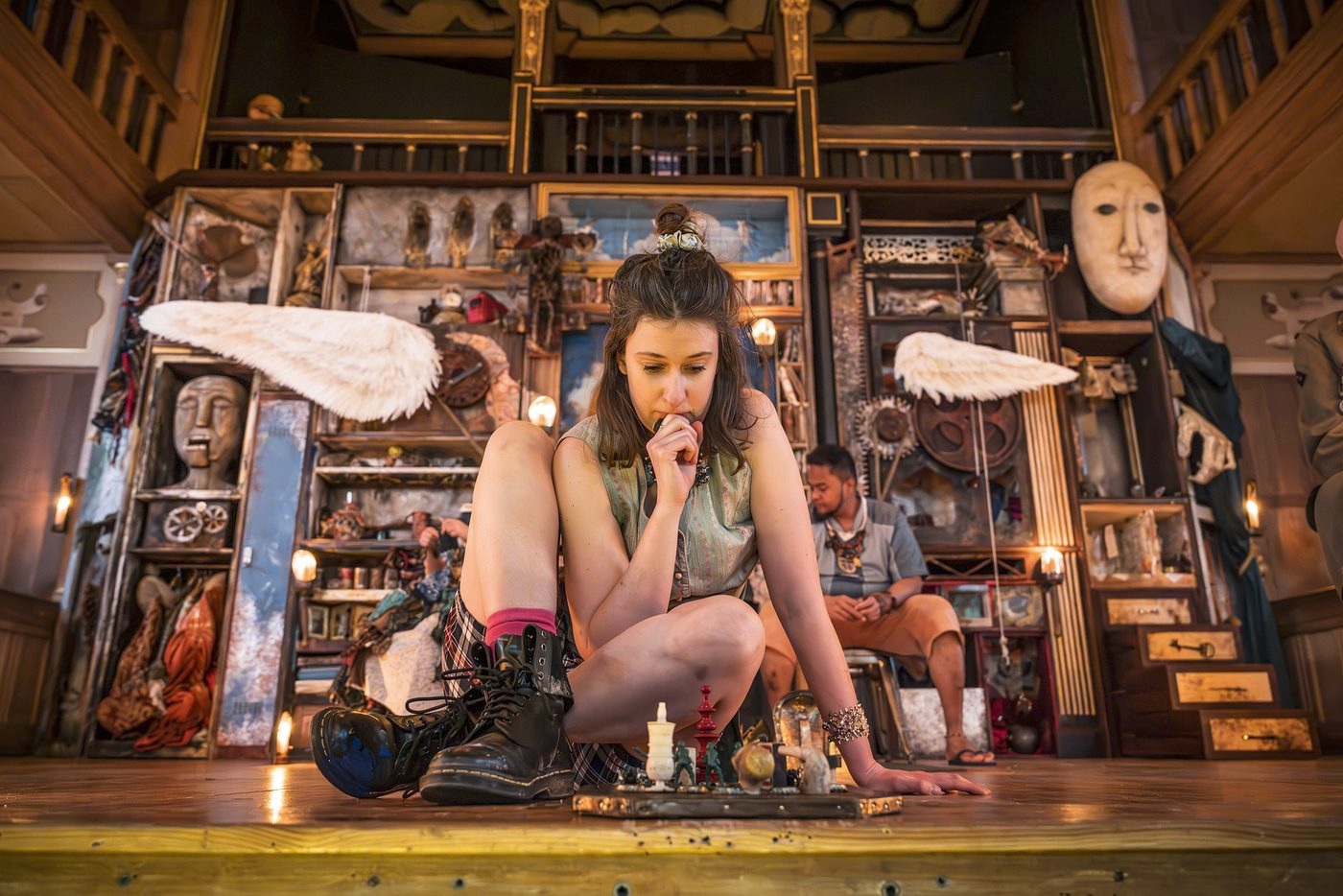
The society of Tim’s enchanted isle seems ethical and cooperative, in a sense. Prospero, Miranda, Ariel and Caliban are onstage together throughout, Ariel knitting a scarf, Caliban and Miranda using candlesticks, a wooden boat and an encrusted stiletto to play out the story of Prospero’s banishment and inhabiting of the island. But the avuncular benevolence with which Prospero seems to encourage and play along with his family blood and chosen only makes his aura of control the more insidious. The final words he speaks, “I am ready”, repeated from the first act, are chilling: far from escaping the island as they might or ought, the quartet are doomed to relive these scenes again and again.
On the one hand, this is a joke: that’s theatre for you! Or, as the clowns Stephano and Trinculo yell a couple of times: Shakespeare!! But on the other hand: what does it mean to play The Tempest as the story of a demagogue who refuses to let go of power, who repeats cycles again and again, despite every attempt to change the story, in the age of Trump and Putin?
To be honest, in this first viewing, I couldn’t have told you. It wasn’t just the pillar blocking the view: it was also that my £40 ticket didn’t even enable me to see The Tempest that Tim Crouch intended. A key actor, Faizal Abdullah, who plays Caliban, wasn’t available for that performance, so his role was taken by Finn O’Riordan, who did an excellent job, all things considered, but is very much a white man. And something about the production wasn’t legible to me when the man playing Caliban became interchangeable with the men cast in roles of power.
But maybe I would have been bamboozled either way, given how detailed this Tempest is, how complex in its thinking. As I reflected on it that day, that week, anything that occurred to me felt insubstantial and elusive as a dandelion spore. Briefly I considered: the damage that might be wrought on the psyche in re-enacting day after day scenes of past conflict or pain (a damage I can’t look too closely at just now, because it’s also become wrought into my own parenting relationship); theatre as a place of breaking the rules only for the rules to be reinstated when the revels are ended; the ways in which a man might seem to let go of power, might seem to share language, might seem to invite collaboration, only to pull rank at whim with an aggression that terrifies (again, I have been in those rooms and now is not the time for memory to return to them). Something in the casting, a particular dynamic, a particular – and off the thought floated, out of reach.
Since then, two excellent reviews have been published of The Tempest; one by Josh Coates, who also had the “something in the casting” thought but actually grasped and planted it, grew the thinking into a full and fascinating account of how Tim’s “metatheatrics aren’t just concerned with the structures of theatre but the infrastructure of theatre”. And one by Duska Radosavljevic, which I’ll return to later. These were exactly the pieces of writing I was desperate for when scouring reviews of The Tempest. But Duska saw the same performance as me (a lovely coincidence), and Josh didn’t mention Faizal Abdullah. This feeling of not having seen the work properly kept nagging at me, and so I tried again.
*
My second ticket for The Tempest cost £15 – extra cheap because the view is extra restricted. Whereas the Almeida’s £15 restricted view seat is in the main stalls, in the Sam Wanamaker this ticket put me on the musicians’ gallery behind the stage. So that entire, gorgeous, sculptural set design by Rachana Jadhav, itself a play within the play, was lost to view, because it was literally under my nose. Apparently, along the balconies, there are those weird fisheye mirrors that you get on tricky junctions, for people in the musicians’ gallery to see the set, but I didn’t notice them because I was focused on the front three-fifths of the stage. Anyone who went towards the back of the stage disappeared for me – like magic! But not a good kind.
To be fair, I didn’t actually pay for this ticket because Tim Crouch bought it for me: the press office never responded to his email asking for a ticket for me, and he’s yet to share his bank details. I’m enough of an ungrateful wretch that when he asked me how the seat was, I blurted: “It was terrible!” But, I got to see Faizal Abdullah (as long as he wasn’t at the back of the bloody stage), got to see how his Caliban relaxes in his flip-flops, got to think about why he might be wearing a Gascoigne football shirt (another thing to come back to), got to enjoy how he interacts with Miranda, her wide-eyed naivety balanced by his irony.
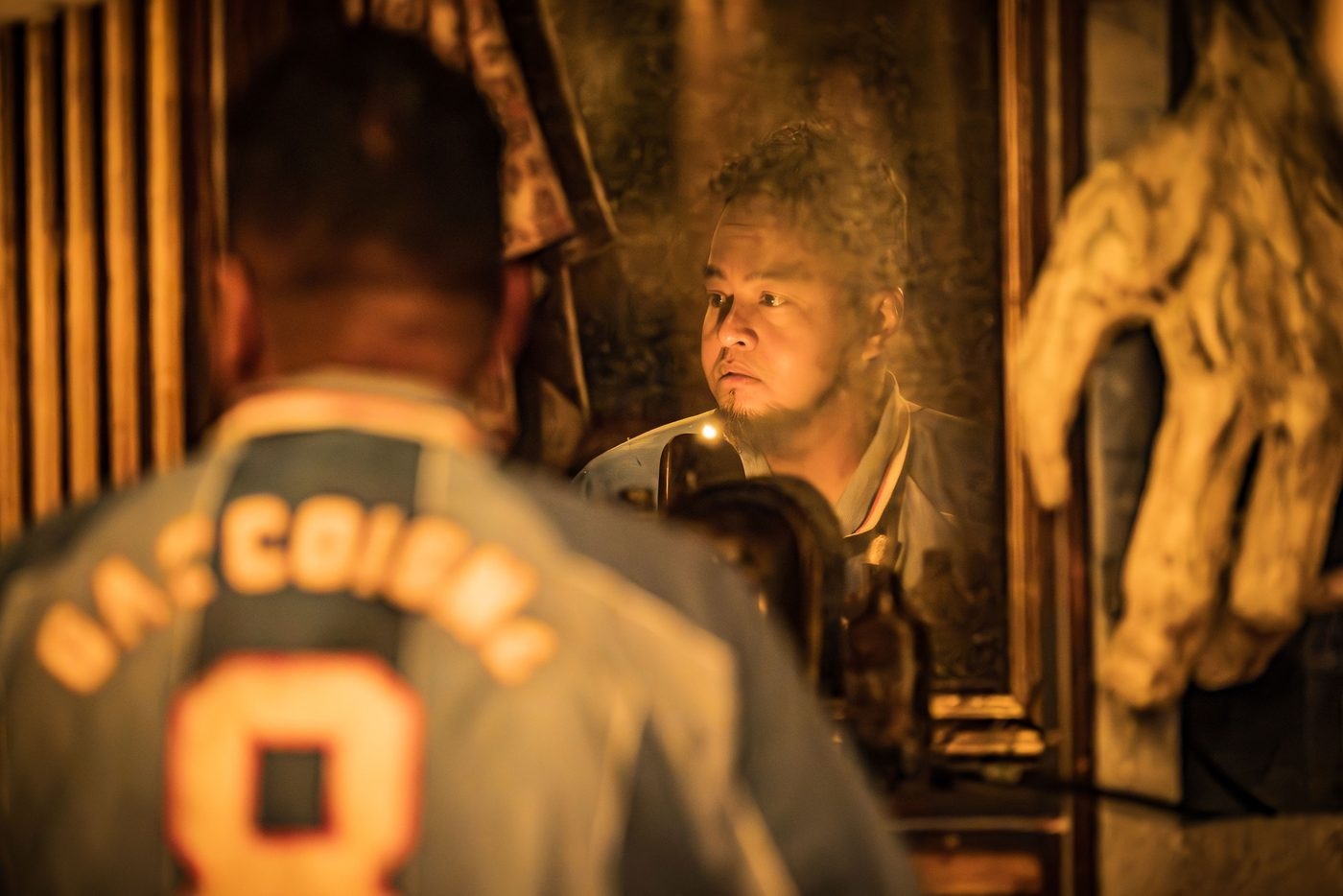
Most importantly, I got to hear him, the firecrackers of Malay he sets off through the text, upbraiding Prospero for his acts of colonial entitlement. Confession: I knew nothing about Malay as a language until I made a somewhat glib comment about its use in a show by (Tim’s friend and often collaborator) Andy Smith in 2019, and received an email from Corrie Tan, now artistic director of the Asian Dramaturgs’ Network, grappling with what I’d written. “Malay”, she wrote, “is one of the official languages of Singapore, where I’m from. It’s a language that’s spoken by a huge swathe of the Nusantara, or the Malay Archipelago, but in Singapore it’s spoken by our most significant minority group, the Malays (the indigenous population of Singapore who are largely Muslim and now make up only 15% of the country after the British colonial project and massive Chinese immigration throughout the 19th and 20th centuries).”
Faizal is also Muslim-Malay-Singaporean: in speaking Malay he extracts Caliban from Shakespearean abstraction, allows the character specificity and an active resistance. Are his words direct translations from the text? Are they his own creation? Either way, the manner of Tim-as-Prospero’s response – eye rolling, hand circling a mime of “blah blah blah” – is practically that of the little England bigot apoplectic at hearing a foreign language spoken on “their” streets. Who probably thinks it’s right and natural that the official language of Singapore is English.
In another email, Corrie told me some fascinating stuff about theatre in Singapore, how “multilingual performance is so commonplace in Singapore and Malaysia that it’s often taken for granted here that playwrights/practitioners will play with the texture and weft of languages and dialects. Our everyday creole often incorporates anything from 2-5 different languages and dialects, with English acting as a sort of glue or base, so encountering consistently monolingual performances in the UK was initially quite a shock to me, as if everything had flattened out somehow.” She also shared with me a review she’d written about a Singaporean production that looks at trauma and historical memory, in which “language plays a substantial role in shaping and shape-shifting revisionist histories” which I thoroughly recommend as a scintillating example of the cultural reach of critical practice.
Key to the Prospero-Caliban relationship is this question of revisionist histories: Prospero insisting on a story of benevolence, Caliban on autonomy delegitimised and erased. Why Singaporean-Malay as the language to disrupt this telling, and not any of the umpteen other languages of countries once colonised in the name of English supremacy? Perhaps it’s no more complex than that Singapore is an island, and so is Jamaica – the voice Naomi Wirthner gifts to Ariel – and there are delightful ways in which Tim’s Tempest takes Shakespeare very literally: see also how a single line “the isle is full of noises” becomes an extraordinary dramaturgical choice to include two singers, Emma Bonnici and Victoria Couper, who flit about the space the way Ariel does in other productions, chanting and chiming and squawking like tropical birds.
There’s another excellent example of critical writing as cultural intervention that I recalled thinking about Faizal’s Caliban, his refusal to speak the language of Prospero, which is also the language of Shakespeare, which is also the language of a burgeoning empire. In his review of Dave Harris’s play Tambo & Bones, Tom Six relates how “the technological form of western theatre developed interdependently with the technology of race”:
“As Noémie Ndiaye argues in her excellent recent book, Scripts of Blackness, “early modern performance culture produced blackness as a conceptual resource available to all European spectators via techniques of racial impersonation and scripts of blackness that, in their multiplicity, could cater to various classes, factions, and sexes” (pp. 22-23). In other words, the theatre of Shakespeare’s time (in which actors used techniques of blacking up drawn, for example, from medieval practices of representing devils on stage) proved a crucial aesthetic resource for the colonial project of producing and naturalizing racial categories.”
Faizal’s Caliban rejects that project, does all he can to shape his own subjectivity, in defiance of Prospero’s racial categories, and yet remains trapped, an island within an island, unable to cross to another shore. And for all the ways in which Tim’s Tempest messes with Shakespeare – plays games, scatters the actors across the auditorium, causes chaos, then throws up its hands and yells, Shakespeare!! – it too remains trapped by the industry that has grown around the Bard, in which it is somehow OK to charge £40 for a ticket that is restricted view, and more than a quid for a ticket that cuts off view of two-fifths of the stage. “What would it take to make theatre part of “life in rehearsal”?” Tom Six asks at the end of his review of Tambo & Bones, which is also a call to “abolish the stage”. Prospero, Miranda, Ariel and Caliban live a life in rehearsal, and because there are no easy answers, it is not an easy existence.
*
The third ticket for The Tempest appears on stage, towards the end of the production. The woman scolded for using her phone turns out to be a gender-switched character in the play, Antonia: Prospero’s sibling, who usurped his position as Duke of Milan. This I could see from the vantage of the £40 seat, but not from the musicians’ gallery; in fact, for entire rows of people sitting on the same side of the theatre as Antonia – including people who had paid £80 for their tickets – this twist was basically opaque. In the interval when I wandered out of the musicians’ gallery, I overheard several people who had no idea the phone user was a performer.
Antonia is a woman of money and influence, who wears a pussy-bow blouse – for anyone not literate in fashion mistakes of the 1980s, this was the favoured clothing article of one Margaret Thatcher – and takes another call during the play from a man called Charles, to whom she simpers that she’s had to show her face at a function at the theatre. When Prospero demands his seat back – the seat of Milan – she shoves her theatre ticket at him. Again, it’s a joke – you want your seat? Take it! But the complaint Antonia delivers as she storms out of the theatre, that this is all nonsense, she knows The Tempest and this isn’t how the play goes, felt uncanny to me, because it expressed the exact same sentiment, almost verbatim, as that of the woman who left her £80 seat at the interval. Art imitating life imitating art, in a discombobulating mobius strip.
In her substack review, Duska Radosavljevic figures Antonia as “a woman that had internalised patriarchy rather than one that is able to really break through it” – Thatcher all over, right? But this thought reminds me of an argument my mum once had with one of my most loved friends: he, gently, trying to get her to see the evils of Thatcher, her accusing him of not being a feminist, for failing to understand how Thatcher was a woman in a man’s world. In The Tempest, that man’s world is Alonso’s, the Duke of Naples, here dressed as a Hackney bro with a job at Google who DJs at the weekend. It’s not the world of his nobleman Gonzalo, in whose utopian republic there would be “no name of magistrate … riches, poverty, and use of service, none”. The speech sort of drifts, finds nowhere to land: deliberately, I think, a sly invitation to dismiss Gonzalo as back on his abolitionist hobby-horse. He shuts up faster if you ignore him.
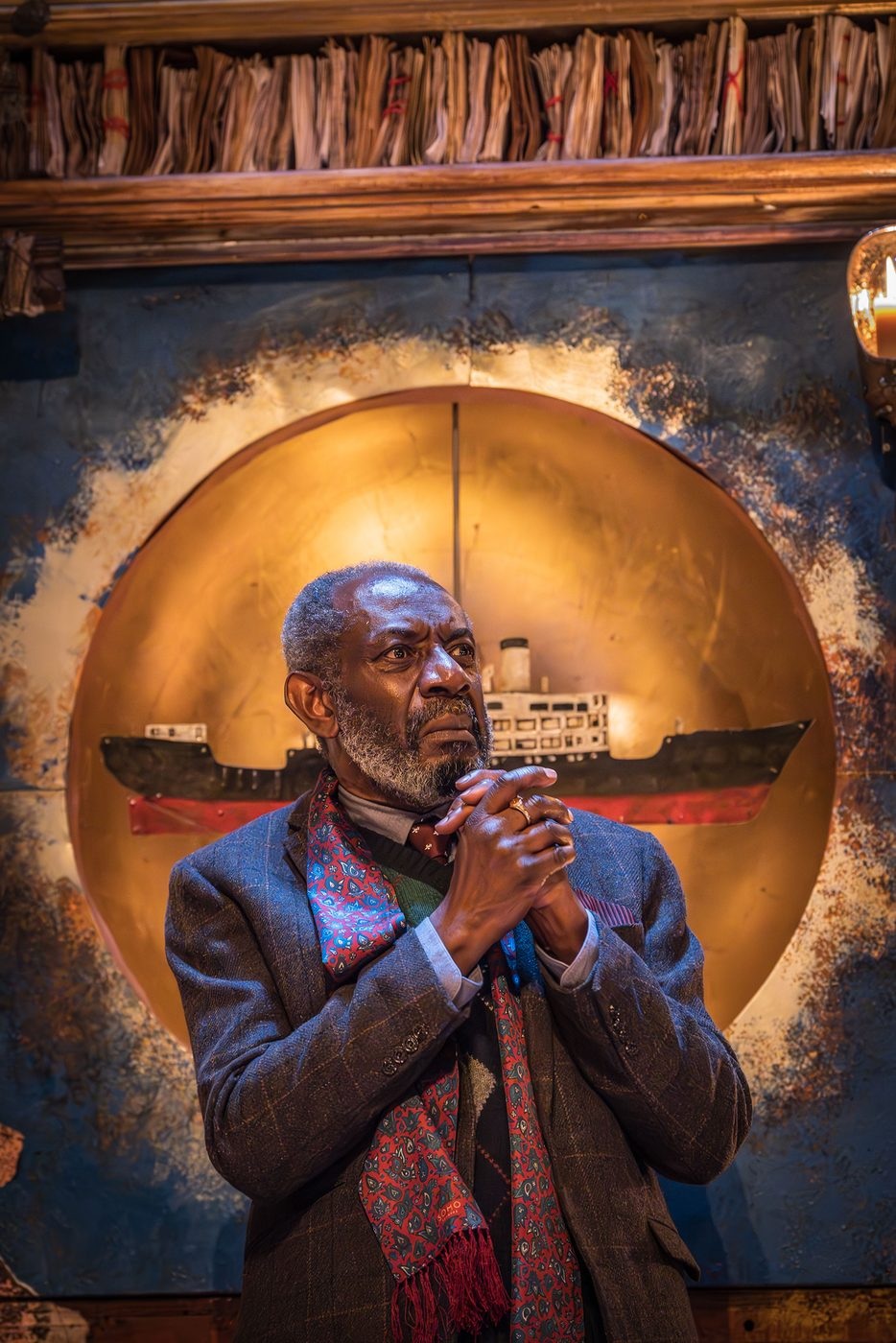
Although he’s been outcast from it, the man’s world is also still Prospero’s. In her “official” review of the play, Duska notes that while “the actor Crouch’s Prospero is often an angry and shouty paterfamilias, the director/adaptor Crouch’s Prospero has had most of his own lines cut and reapportioned to the other ensemble members”, offering Tim’s own explanation that this is a “decentring of power”. But if I’ve learned one thing from watching shows by Tim Crouch over the years, it’s that you should never, ever trust a man played by Tim Crouch – least of all one who claims to be decentring power. Think of Prospero as the equivalent of Miles, the cult leader in Total Immediate Collective Imminent Terrestrial Salvation also played by Tim, and this decentring of power becomes – thrillingly, taxingly – a sham.
But, again, this is theatre! It’s all a sham, all make-believe! But what does it mean to make belief? As Josh and Duska note, permutations of this question are central to all of Tim’s theatre: it’s why the seat and the ticket are so important in this Tempest. Buy a ticket and you become part of the making, embroiled in the hierarchy and the politics and the social expectations. Depending on where you sit, you might have Jo Stone-Fewings, silicon bro Alonso, literally clambering over you. In the musicians gallery I sit beside Trinculo and when their phone also goes off – playing an Italian translation of the Shakespeare – I’m the person who switches it off. Globe audiences, of course, are particularly admired for the alacrity and energy with which they become part of the world of the play. But what responsibility for making and believing do audiences carry with them when they leave? Are you making more patriarchy, more capitalism, like Alonso, Sebastian, Antonia? Are you clowning your way through life, like Stefano and Trinculo? Are you awed by the wonders of the earth and all its creatures, like Miranda, but trapped in a cycle of repeating humanity’s mistakes?
Another way of putting this might be to return to a question Tim once asked, in a collaboration with his friend Andy Smith, in which he again played a charismatic but actually quite aggressive man: what happens to the hope at the end of the evening, when you leave your theatre seat, and return to the world as it is? Do you keep telling the same damn story over and over, like Prospero? Or do you try to tell a different story, eyes on a different horizon, even if – like Caliban – you will take three steps towards that horizon, only to be yanked two steps back?
*
I almost forgot. The Gascoigne shirt worn by Caliban. I assume the costumes were designed by Rachana Jadhav also and the more I think about them, the more I think they too are integral to the argument of the production. Sebastian – who conspires with Antonia to murder first Alonso and Gonzalo, and later Prospero too – smug in a basic suit; when I saw The Tempest the second time, Finn O’Riordain had had to step into that role, and was an unquestionably excellent substitute for Colin Michael Carmichael. Sophie Steer’s Miranda in DM boots – the shoe of choice for feminists of a certain vintage. And the Gascoigne shirt redolent of an era of lad culture, the money in football going stratospheric (in 1988 Gascoigne signed up with Tottenham Hotspur for a then-record British fee of £2.2 million), the slow drag of Thatcherism following her resignation in 1990, and its reinvention as New Labour, around the same time as Gascoigne’s football career went into decline. When I say this Tempest is detailed and complex, it’s not because I know Tim Crouch well enough for him to buy me a ticket to see his show (bless him). It’s because – as much as anything can be in this era of fake and hyperbole – it’s a fact and it’s true.

