On Catherine Hoffmann’s Wormhole of our Formation, by Eirini Kartsaki
‘Streams gurgling, rushing, flooding paths. All is let loose, the rain doesn’t stop, keeps cascading down. It’s never going to let up is it? Ever?’ Wormhole of our Formation is a lament, and a collapse, a state of emergency. It talks about rage, class, despair, desolation. It invites us to let go of pretense, admit defeat and yet storm our heart with bravery.
It starts slowly and it starts in wetness. There is lots of water and I never seem to get dry. It is not tears, at least not visibly. There are three storms that storm into my existence and won’t stop. Dudley, Eunice and Franklin. There are voices of people overlapping and repeating, male figures taking advantage of obliging women, parts of the body that hurt, blood gushing from the inside. There is a host of a B&B serving beans. There are always women unable to breath, whose teeth are falling out. There is daytime television and radio shows that talk about menopause and the symptoms of HRT and how to hydrate. There are some insightful observations about jacket potatoes. But mainly there is despair.
This is the kind of despair that does not have a name. It is overwhelming, gushing like blood, and cannot be sustained. This is the kind of despair that I, too, have felt many times, in moments of the everyday – hearing someone vacuuming in the room next door, losing one’s debit card. And there is relief, but only momentarily. There is relief in knowing that this kind of despair is shared, and commonly lived. There is relief in thinking momentarily, when listening to Catherine Hoffmann’s lament, that we may escape. But again, and again, ‘the deluge continues, and all I can do is bow head towards chest and grit my teeth.’ Through the clenched teeth, the lament turns into a vociferous cry, but not for help; it is more like a cry to exercise the lungs again and make sure they can still fill up with air. And the storm continues, and I keep bleeding, shaken with anguish: ‘I don’t want to lose it in a small room, so far from home. But I have’.
There is pain here and there is injury. The injury is particular to the bodies that feel, that change as they get older and that can experience the neglect of medical systems, the apathy of the world. There is a mode of existing that feels so familiar it is seldom questioned. It is the mode of compulsive caregiving, because there is no other choice. That mode of living, that demands that we help others before attending to ourselves, necessitates disaster. Because it is only in disaster, in planetary disaster, when the trees are shaking and the earth is flooding, that we might stop.
Hoffmann creates a staged radio show about a devastating road trip, reminiscent of Jack Kerouac’s On the Road. Or would be, if Kerouac were bleeding uncontrollably and finding shelter in B&Bs in England and Wales on the way to look after a family member. In 2023, the artist invited me into her creative process to offer dramaturgical advice. I also saw the piece at the Cambridge Junction. Every time I saw Wormhole in rehearsal or live performance, I discovered a different layer of the work. Wormhole of our Formation is a fierce, profound piece about human existence. It manages to articulate the most difficult, even if ordinary, of feelings: feelings of despair and isolation. But this is no ordinary collapse, it is dishevelled, messy and broken. And there is no road to salvation, only a repetition of falling. The violent storms, the peri-menopausal fever and the uncontrollable bleeding, all embody brokenness, within which something rises. A clarity that we are owed more than this, that the escape will look different than what we had imagined. As Franco Berardi suggests, we can only escape chaos and despair through seeing differently and understanding our exhaustion, which is not an individual problem, but a systemic one. We cannot hold beyond a certain point.
In 2024 I abandoned the life I built consistently for twenty years. This was not a decision as such, but rather a violent push– someone booted me out of my life in a violent way. The violence I felt had to do with an extreme feeling that I can’t go on any longer, that the life I was building was killing me, that I was going down if I kept pedaling that direction. I feel an intense connection with Hoffmann’s Wormhole of our Formation. Because it is asking precisely those questions: what happens to our life when there is a flood of bullshit storming into it and there is nowhere to go? Hoffmann’s performance aptly embodies the impossibility of escape, caught amongst three storms that took place in Britain in February 2022. The disruption and damage they caused was devastating for people, properties and livelihoods. Hoffmann was on the road during these storms, on the way to visit a family member that needed urgent assistance. The performance asks questions about women’s health, female emotional labour and compulsive caregiving. It narrates the events of 2022, but goes deeper and asks further: Which parts of us can take this type of bruising? How much do we need to bruise before we know it is time to stop? And how much pain and deterioration will justify one’s existence?
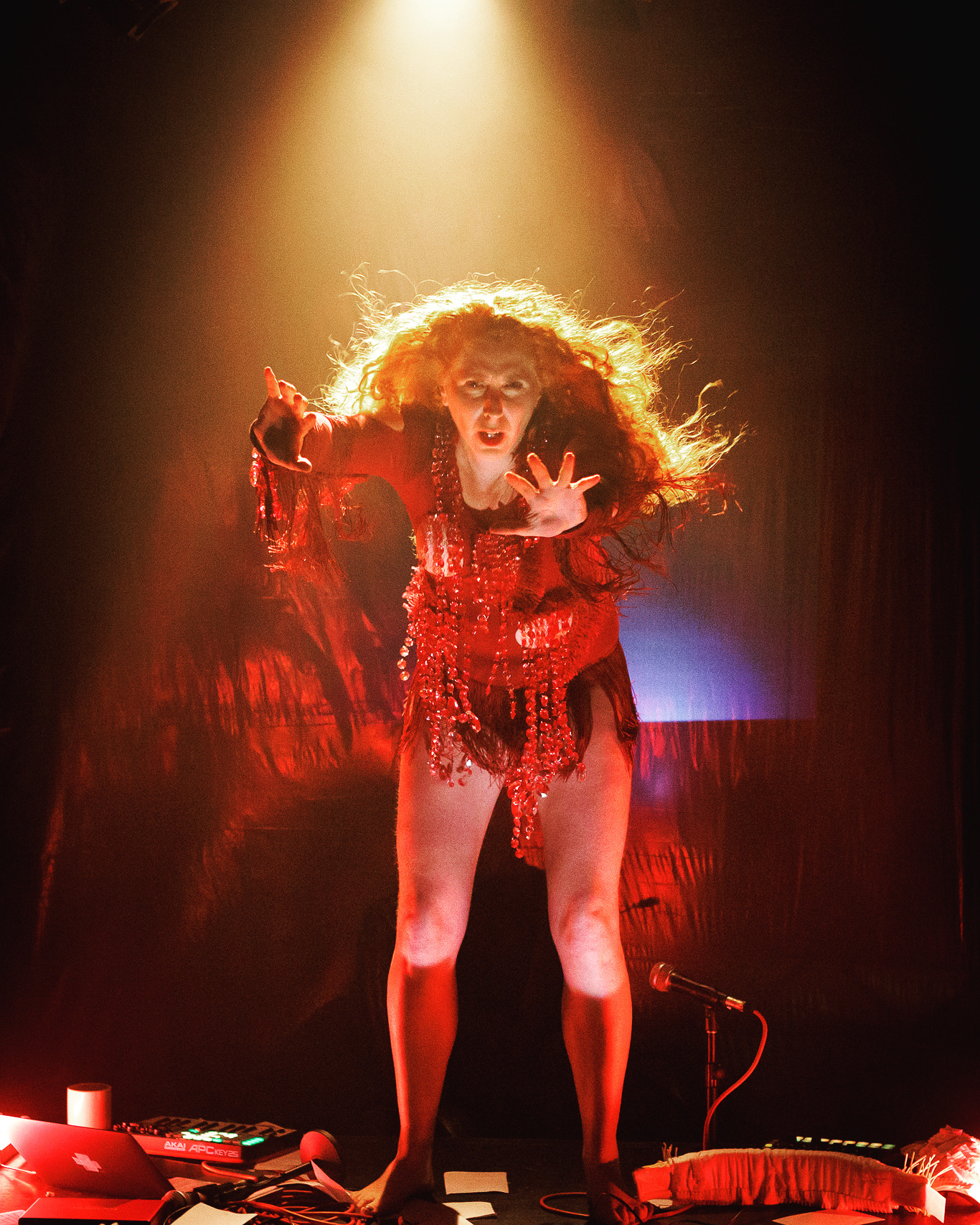
The performance ends with an astounding image of Hoffmann (in a remarkable costume by Lara Buffard) trembling. An industrial fan is blowing into the space, and hair, tassels and paper all turn into a whirlwind. These intense weather conditions open a portal to a different time and place. Somehow, this moment becomes a doorway to something that is hard to define but is felt as the antidote to despair. This is a feeling that we do not exist alone, that our survival is placed on a long lineage of others, who have struggled and prevailed. In a way, this shaking body in front of us is conjuring history and is channeling the lives of others before us that we can connect to for strength and wisdom. The only thing we may need to achieve this connection are intense weather conditions.
Written in advance of Catherine’s performances of Wormhole of our Formation at BAC, London, 8-9 May 2026.

