In response to Máret Ánne Sara’s Goavve Geabbil
by Anette Therese Pettersen and Diana Damian Martin
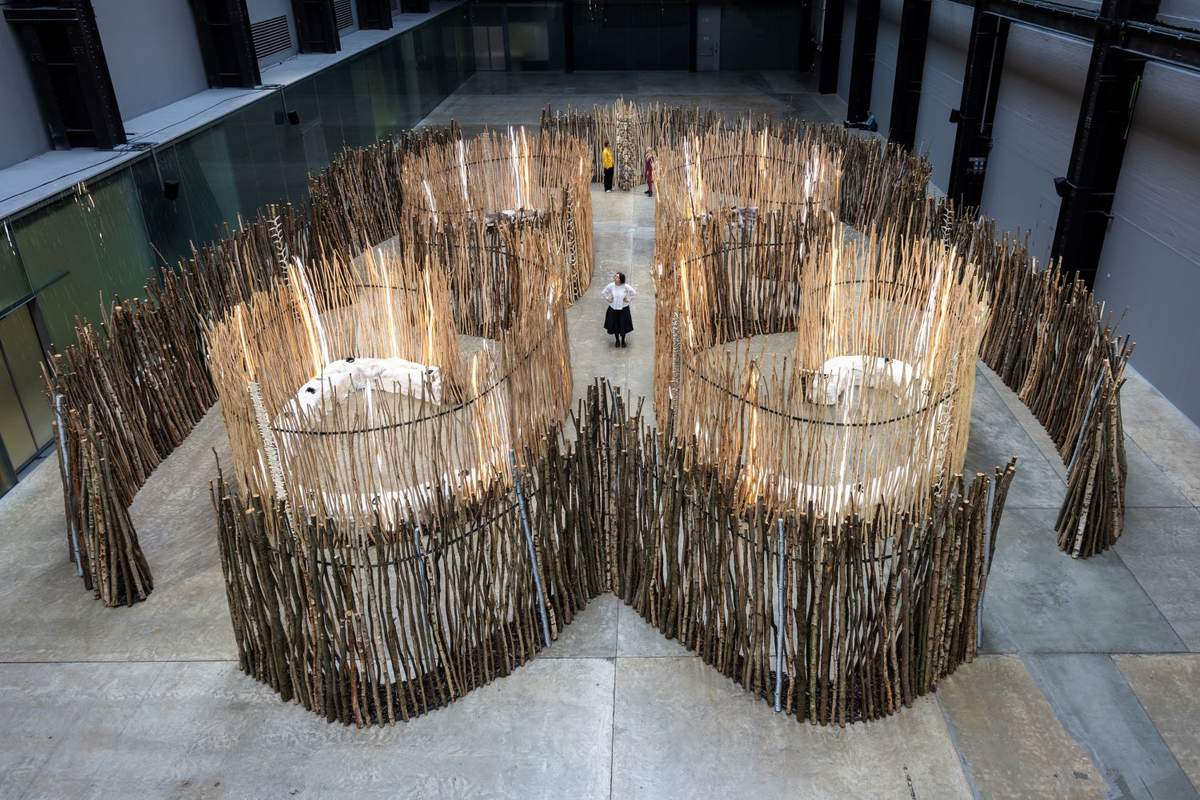
Hyundai Commission Maret Anne Sara. Photo © Tate (Larina Fernandez)
*
This is a text written in relation, as two travelling voices and bodies.
It is a text emerging from a shared visit to Máret Ánne Sara’s Goavve Geabbil, but also, a text about shared journeys and meeting to write and think together, where we can, as we can.
This is also a text written in sprints.
Sprints through the city.
Sprints through time.
Sprints online.
The sprint as a structuring movement.
Sprints in between the many encounters with our worlds.
This is a text written in two voices, that sometimes become one, about walking through a nordic landscape in the Turbine Hall in the thickness of London winter.
*
The first thing that strikes me (us), as we are making our way through the Turbine Hall, is the smell. Soft, almost like perfume, somewhere between the floral and something else organic. Walking past Ánne Sara’s display of reindeer skin as we enter the Turbine Hall – skin stretched across near-full height hanging cables – is a quietly intimate experience.
Ánne Sara weaves sensorial, sonic and material traces on Sámi reindeer herding practices, inviting a resonant dialogue over necessity and extraction, respect, care and interdependence, and people, animals and place. The installation – which speaks to practices across Norway, Sweden, Finland and the Kola Peninsula in Russia – brings such traces as reindeer hides, wood, and the smell that reindeer leave behind when they feel scared. These are held by a larger structure that choreographs our movement and attention, a Geabbil, reminiscent of the internal anatomy of a reindeer nose, which is particularly adaptive in supporting survival in very cold conditions by heating air. Knowledge-keepers greet us in audio stories, while scents drift alongside carcasses, power cables and other traces of the many worlds that collide amid ecological crisis.
Walking further into the Turbine Hall the soundscape is gently gripping, easily folding into the busy sonic environment. Moving through the hides, with their undulating choreography and moments of listening, takes a while to land. I feel the complexity of what it means to stage ancestral knowledge in the divergent energies of the contemporary museum. I think of Hito Steyerl asking, ‘how can one think of art institutions in an age of planetary civil war?’ I think about the many wars waged, including in Goavve-Geabbil. What relations do we open ourselves to, what might we hold, in such times that demand our actions? In Goavve-Geabbil, we learn that eallit stands for ‘to live’ in Sámi, and it shares its roots with eallu, that is, ‘herd’. I think about the migratory lives of reindeer, and how I – and we – have arrived in the Turbine Hall, again and again, from the north and east of Europe. The choreography of moving through and standing still.
We move our bodies further into the space, weaving ourselves into the spiral shaped installation, while we catch up on each other’s lives. We talk about everyday stuff, and about art. We sit on white deerskins, listening to excerpts of conversations or talks (by Ánne Sara and others) about living in the Sapmi areas in the north, as small hairs from the skins attach themselves to us, to our clothes, carried with us as we get up and start walking again, out into London, falling off as we sit down on the tube, or maybe all the way to the apartment, maybe even back to Norway.
The installation resonates beyond the Turbine Hall, in gentle frequency with the histories and impact of industrialisation, in search of a different form of dialogue: that of listening intently. What is striking in being alongside reindeer skulls and skins, soundscapes of industrialised farming, storytelling and relation, within the haunting presence of the Hall, is the noise that engulfs our own encounter: not just the sonic environment, but the many tangles that interfere, and the apparent vulnerability in this invitation to hear. The Turbine Hall holds a parallel life in the iconography of contemporary museums: cavernous, postindustrial. Goavve-Geavvil cuts through some of the cynicism of the space, inviting stories in. The effect is like an echo, a resonance, with multiple histories embedded in the space, that ask for a listening relation. Listening that renders the institution fuzzy.
We are struck by some of the lukewarm, even hostile reception of this work across the UK and Norway. “Unimpressive” was the impression left by several of the critics. Not doing an Olafur Eliasson – turning the Turbine Hall into something else, somewhere else – seemed to be the fault. The Disneyficiation of the art world is once again upheld by critical expectations, while assumptions about what Indigenous practices look like, in the imperial hold of the Turbine Hall, are left lingering. As we stood there, side by side, in quiet conversation, it seemed obvious that transformation wasn’t really the invitation here; instead, there is a spaciousness of travel left open. A series of stories, of open conversations, amid the movement of people in and through the Hall, and in and through land, and across borders, and across time.
The modes of the work deeply engage processes of industrialisation in relation to Indigenous Sámi rituals. The installation gathers testimony from Sámi communities about their relation to reindeers, the place of ritual, grief, loss but also remembrance, and contrasts this with the ways in which industrialisation erases the messiness, complexity and ethics of co-habitation and interdependence in entangled ecologies. Balance and respect involve one taking what is needed and ensuring nothing is wasted; honouring this relation of care, and attending to the power dynamics that shape human-animal connections.
The contrasts of metal and wood, the produced/man-made and the organic, are an underlying tone in both installation and the discourse. In Sara’s work nature is not something outside ‘us’, outside the urban surroundings of the Turbine Hall, but rather: the urban also is part of nature. Taking only what you need, and using all of it, is valuable advice for the institution, not only an approach in the slaughtering of animals.
By bringing the natural materials into the machine-like hall, the installation becomes less of a retreat and more of a reminder:
“Goavve-Geabbil stands as a living monument, with Sara calling on us to remember that ‘nature is not an endless resource to exploit. If we expect to receive from it, to sustain life for all beings, we must also ensure its health and ability to regenerate’. Through this work Sara upholds Sámi science and philosophy as progressive, powerful and vital to shaping the future of our shared world.”
It is strange that calling on someone to remember that “nature is not an endless resource to exploit” is considered progressive.
We return to Steyerl’s question; “How can one think of art institutions in an age of planetary civil war?”, and consider it alongside the Sami words eallit and eallu – to live in and herd. To live in, and as, a herd. How can art institutions invite us to think and to live, as a herd, both acknowledging the histories within the museum and outside of it? How many worldviews and definitions can it contain? The Turbine Hall is an archive that invites Ánne Sara’s installation – with its proposition of how to live – to challenge it. The installation invites us to a silent speculation of possible ways of living as a herd, inside and outside.
Máret Ánne Sara: Goavve-Geabbil
Turbine Hall, Tate Modern
Visited on 4 November 2025

